In this guide 10 sections
- 1 Who Do You Have to Check?
- 2 When Does the Check Have to Happen?
- 3 How Do You Do the Check?
- 4 What Records Do You Keep?
- 5 Who Carries the Duty if an Agent Acts?
- 6 When Do You Need a Follow-Up Check?
- 7 What If a Tenant Fails a Follow-Up Check?
- 8 How Do You Avoid Discriminating?
- 9 What Are the Penalties?
- 10 Where Does This Sit With Everything Else?
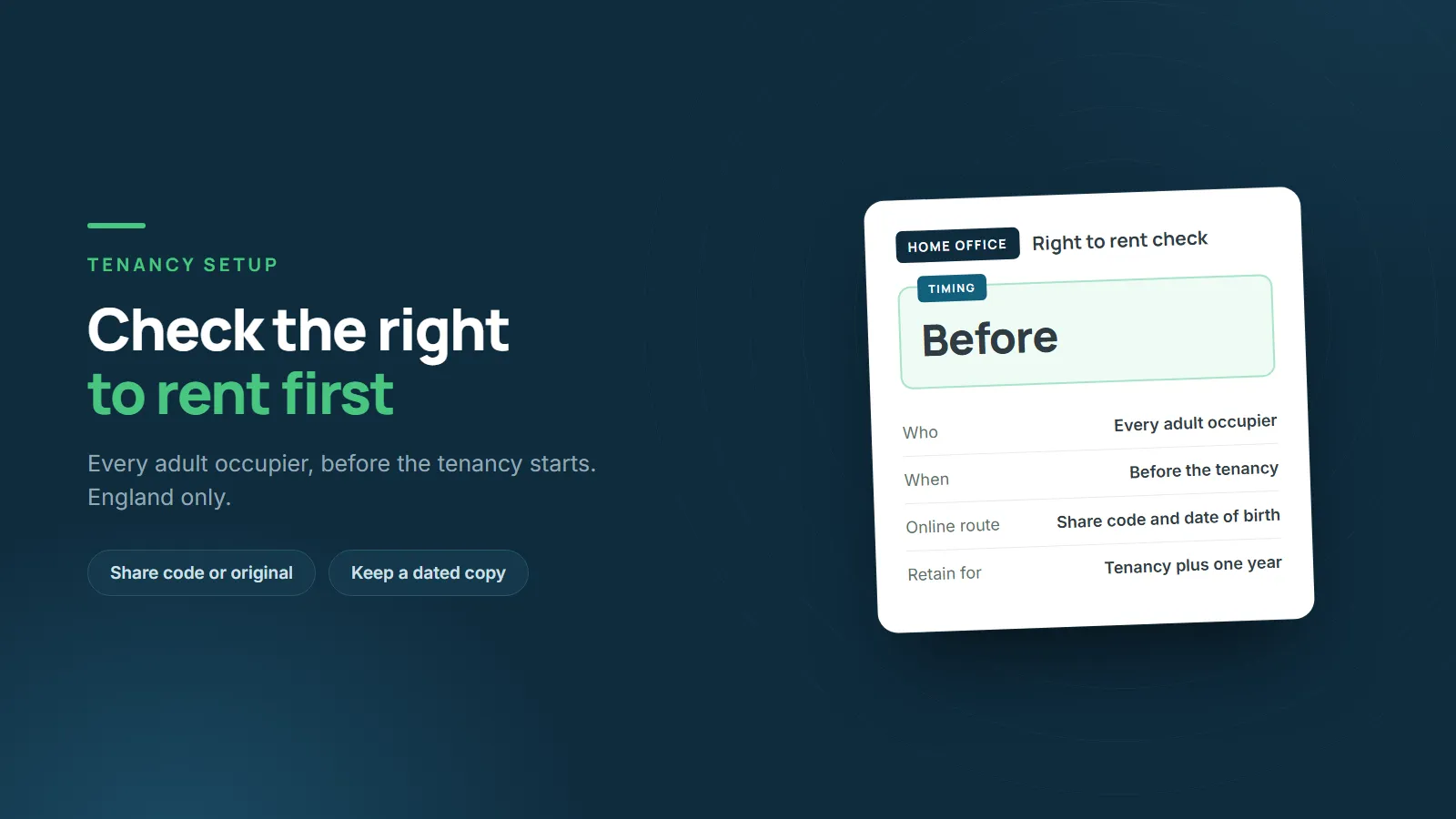
You must check every adult who will use the property as their main home before the tenancy starts, keep a dated copy of what you saw, and diarise a follow-up where their permission to stay is time limited.
The checking part is well covered elsewhere, including by the Home Office’s own service.
The part that is not well covered is what happens afterwards. Failing to report a tenant who fails a follow-up check is the element of this scheme that carries a prison sentence, and it is easy to miss because it looks like an administrative afterthought.
Who Do You Have to Check?
Every tenant aged 18 or over, before the start of a new tenancy, whether or not they are on the agreement.
It is about occupation, not paperwork
GOV.UK requires the check on all tenants aged 18 and over even if they are not named on the tenancy agreement, even if there is no tenancy agreement, and even if the agreement is not in writing.
The test is who will use the property as their only or main home. A partner who moves in unnamed is still someone you were required to check.
The exemptions are broader than most landlords realise
You do not need to check tenants in these situations.
| Exempt accommodation | Also exempt |
|---|---|
| Social housing | Accommodation provided by a local authority |
| A care home, hospice or hospital | Tied accommodation provided as part of a job |
| A hostel or refuge | A lease of 7 years or longer |
| A mobile home | |
| Student accommodation |
Student accommodation and mobile homes are the two that surprise people. If you let either, check the code of practice for what applies instead rather than assuming nothing does.
Related: Student landlord insurance
Commonwealth citizens
Where a tenant is a Commonwealth citizen without the usual documents, GOV.UK says to check with the Home Office, because they may still have the right to rent.
That is a case to refer rather than to decide yourself.
When Does the Check Have to Happen?
Before the tenancy starts, and for time-limited permission, within the 28 days before it starts.
The 28 day window cuts both ways
Where the tenant is only allowed to stay in the UK for a limited time, the check must be done in the 28 days before the start of the tenancy.
So a check done two months ahead of a move-in is outside the window. Doing it too early is as much a failure as doing it late, which is the opposite of the instinct on most compliance tasks.
Build it into the letting process
The practical answer is to make the check one of the last steps before the tenancy starts rather than one of the first steps in referencing.
Related: How to protect a tenancy deposit
How Do You Do the Check?
Three routes, and the one you use depends on who the tenant is.
The three methods
GOV.UK lists them: check the tenant’s original documents yourself, use a registered Digital Verification Service, or view the tenant’s right to rent online using their share code.
The share code service is the route for most people with digital immigration status, and it is a Home Office service rather than something you assess yourself.
Checking original documents, step by step
Where you are examining documents in person, GOV.UK sets out five steps.
| Step | What it means |
|---|---|
| 1 | Establish which adults will use the property as their main home |
| 2 | Ask them for original documents proving they can live in the UK |
| 3 | Check the documents show they have the right to rent |
| 4 | Check the documents are genuine and belong to them, with the tenant present |
| 5 | Make and keep copies, and record the date you made the check |
The tenant has to be there
Step four is the one that gets skipped. The check on genuineness has to be done with the tenant present, which rules out doing it from emailed scans.
British and Irish citizens
They can usually prove their right to rent with a British passport or an Irish passport or passport card, current or expired, or a certificate of registration or naturalisation as a British citizen.
An expired passport being acceptable is unusual and worth knowing, because refusing one is both wrong and a discrimination risk.
What Records Do You Keep?
Copies of what you saw and the date you saw it. That combination is what a statutory excuse is made of.
The date is the part people forget
A copy with no date attached does not show when the check happened, and the timing is half the duty. Record the date on the copy itself.
Keep them for the tenancy and beyond
Keep the record for the duration of the tenancy and afterwards. An enquiry usually arrives long after the event, and the file is the only version of events that will still exist.
Agents
Where an agent carries out checks, be clear in writing who holds the duty. GOV.UK covers agents and subletting separately, and an unclear arrangement tends to resolve against the landlord.
Who Carries the Duty if an Agent Acts?
Whoever the written agreement says, and if it does not say, expect it to land on you.
Put it in writing or own it
GOV.UK deals with agents and subletting separately from the main duty, and the practical position is that responsibility transfers to an agent only where that has been agreed in writing.
An arrangement that was never documented tends to resolve against the landlord, because you are the person the penalty notice is addressed to.
Ask to see the checks, not just the confirmation
An agent telling you the checks are done is not the same as holding the dated copies. Ask for the file at the point of letting, while it still exists and the people involved still work there.
Subletting is the gap
Where your tenant sublets, the person who granted that occupation carries the duty for it. That does not help if your agreement never permitted subletting in the first place.
Related: HMO licensing
When Do You Need a Follow-Up Check?
Only where the tenant’s permission to stay is time limited, and the timing rule is specific.
The later of two dates
GOV.UK says to do the follow-up check just before the later of the end of the tenant’s permission to stay, or 12 months after your previous check.
Where there is no time limit on their permission, no follow-up is needed at all.
| Situation | What to do |
|---|---|
| No time limit on permission to stay | No follow-up check needed |
| Time-limited permission | Follow up just before the later of the permission ending or 12 months after the last check |
| Follow-up not done and permission ends | You can be fined |
Diarise it at the first check
The follow-up date is knowable on day one, because it comes off the document you are already looking at. Putting it in the calendar at the point of the first check costs nothing and is the only reliable way it happens.
What If a Tenant Fails a Follow-Up Check?
You must tell the Home Office, and not telling them is the part of this scheme with a prison sentence attached.
The reporting duty
GOV.UK is explicit: you must tell the Home Office if you find out, after a follow-up check, that your tenant can no longer legally rent in England.
It is equally explicit about the consequence of not doing so. You could be fined or sent to prison for up to 5 years if your tenant fails a follow-up check and you do not report it.
Why this is the one to get right
Most coverage of right to rent treats it as a document-checking exercise with a civil fine attached. The checking failures are civil; this reporting failure is criminal.
A landlord who quietly does nothing, hoping the situation resolves, has moved from an administrative problem into a criminal one.
Reporting is not eviction
Telling the Home Office is a separate act from recovering the property, and doing the first does not achieve the second.
Possession still runs through the ordinary route, on Ground 7B, which covers a tenant who does not have the right to rent and carries two weeks of notice.
Related: Section 8 grounds for possession
How Do You Avoid Discriminating?
By checking everybody, every time, in the same way.
The instruction is direct
GOV.UK: check all new tenants, it is against the law to only check people you think are not British citizens, and you must not discriminate against anyone because of where they are from.
Why a uniform process protects you
A consistent process applied to every applicant is simultaneously the compliance route and the answer to a discrimination complaint. Selective checking fails on both counts at once.
Do not screen people out early
Declining to proceed with an applicant because their status looks complicated is where discrimination claims come from. Run the same process, and use the Home Office routes where a case is not simple.
Related: Landlord legal expenses insurance
What Are the Penalties?
Civil penalties per occupier, and a separate criminal offence for knowingly letting to someone without the right to rent.
The civil penalties
| Who | First penalty | Further penalties |
|---|---|---|
| Lodgers in a private household | £5,000 | £10,000 |
| Tenants in rented accommodation | £10,000 | £20,000 |
Those are per person, so a shared house multiplies quickly. On a five bed let, one missed process is a five figure exposure.
Related: Compare HMO insurance
The criminal offence
Separately, GOV.UK sets out that you can be sent to prison for up to 5 years or fined for renting to someone you knew, or had reasonable cause to believe, did not have the right to rent.
GOV.UK gives the examples: you had reason to believe they had no permission to enter or stay, that their leave had expired, or that their papers were incorrect or false.
How a case reaches you
You may receive a referral notice telling you the case is being investigated, followed by an information request giving you the chance to show that you carried out the check.
That request is answered from your file. If the copies and dates are there, it is a short conversation.
Where Does This Sit With Everything Else?
It is one of the checks a possession claim is tested against, and one of the cheapest to get right.
It joins the compliance pack
Deposit certificate and prescribed information, gas safety record, electrical report, energy certificate, the information sheet, and the right to rent file. That bundle is what a possession claim stands on.
Related: What the Renters’ Rights Act means for landlords
It costs nothing but process
Unlike most landlord obligations, this one has no fee and no contractor. It costs a consistent process and a diary entry, which makes the penalties for getting it wrong particularly avoidable.
Comparing landlord insurance for UK lettings is the part of your setup that costs money. This part just costs attention.