In this guide 9 sections
- 1 What Counts as an HMO?
- 2 Do You Need a Licence?
- 3 What Changed on 1 May 2026?
- 4 What Room Sizes Must You Meet?
- 5 What Conditions Come With a Licence?
- 6 How Do You Apply, and What Does It Cost?
- 7 What Happens If You Do Not Licence?
- 8 What Do HMO Licensing Failures Look Like?
- 9 What Does It Mean for Your Cover?
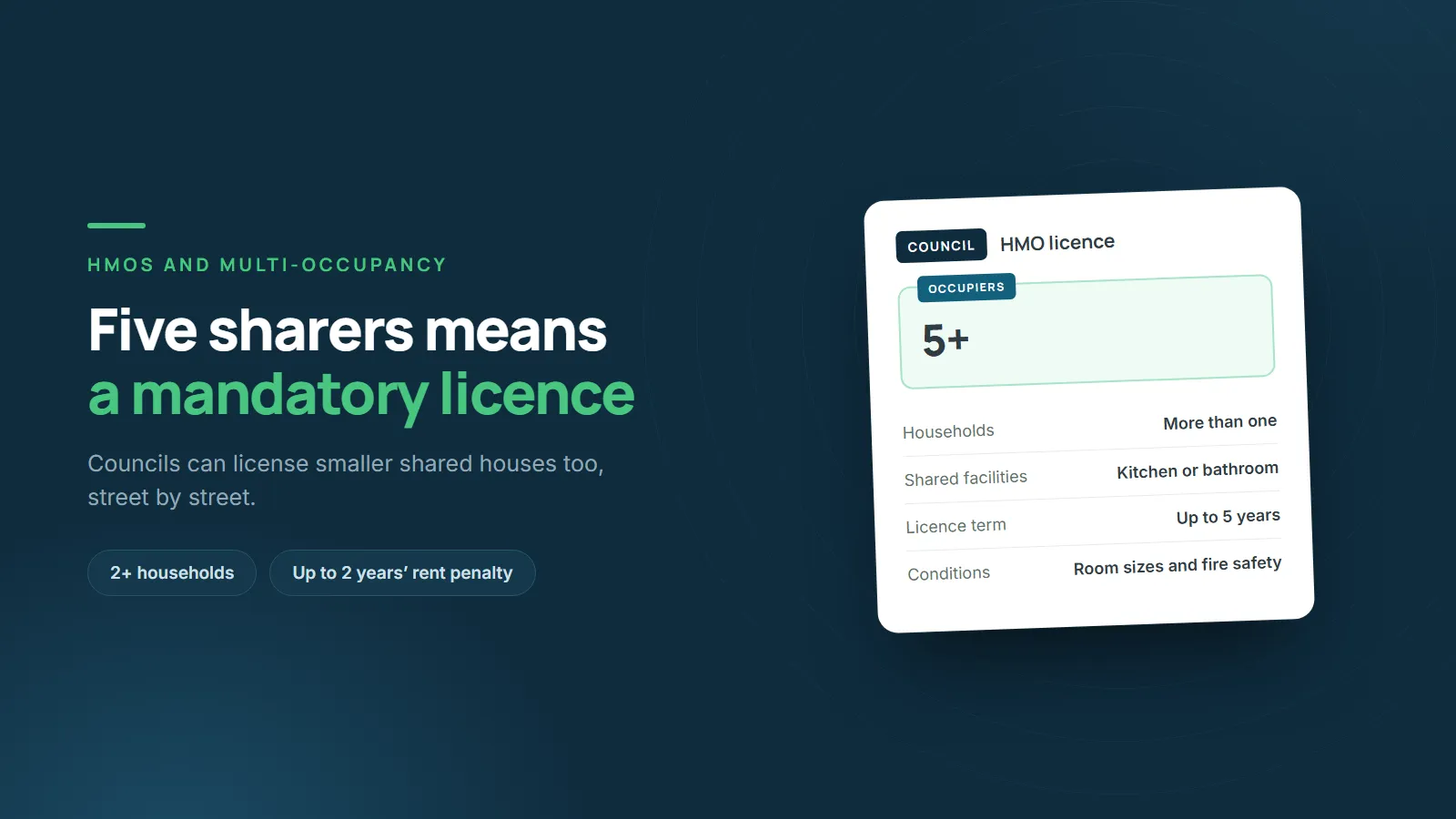
Mandatory HMO licensing applies where a property is occupied by five or more people forming two or more households. Councils can also require licences for smaller properties, and many do.
That much has been stable since 2018. What changed on 1 May 2026 is the consequence of getting it wrong.
The offence now reaches superior landlords, the maximum civil penalty is £40,000, and a tenant can claim back two years of rent rather than one. Most HMO guidance still describes the old figures.
What Counts as an HMO?
Living accommodation occupied by people from more than one household as their main home, sharing basic amenities, with rent paid. A property only has to meet one of the statutory tests.
The three tests
Section 254 of the Housing Act 2004 sets out a standard test, a self-contained flat test and a converted building test. Meeting any one makes the property an HMO.
The standard test is the common one: units of living accommodation that are not self-contained flats, occupied by people who do not form a single household, as their only or main residence, with rent payable, where two or more households share an amenity or the accommodation lacks one.
Two more routes in
A council can make an HMO declaration under section 255 where it considers the test is met. And section 257 catches certain converted blocks of flats, which is the route people least expect.
So a building can be an HMO without anyone having called it one.
What counts as a household
The tests turn on how many households occupy the property, not how many people. Section 254 points to section 258 of the same Act for the definition.
Broadly it covers people related to each other or living together as a couple. Five friends sharing are five households; a couple with three children are one.
A licence is not planning permission
These are separate consents from separate parts of the council, and holding one says nothing about the other. Landlords regularly assume a licence settles the question of whether the property may be used this way.
Whether planning consent is needed for a change of use, and whether local directions have removed any permitted development rights in your area, is a question for the planning department at the specific address. Ask both departments, not one.
Being an HMO is not the same as needing a licence
Every licensed property is an HMO, but not every HMO needs a licence. The definition sets what the property is; licensing decides whether you need permission to run it.
Both matter, because HMO management regulations apply on the definition regardless of whether a licence is required.
The management regulations apply either way
Separate regulations govern how an HMO is managed: fire safety, water and drainage, common parts, waste, and displaying the manager’s name and contact details in the property.
They apply because the property is an HMO, not because it is licensed. A small unlicensed HMO is still caught, and breaching them is its own offence with its own penalty.
Do You Need a Licence?
If five or more people from two or more households occupy the property, yes, everywhere in England. Below that it depends on your council.
Mandatory licensing
The 2018 prescribed description order sets the national threshold: occupied by five or more persons, living in two or more separate households, and meeting one of the section 254 tests.
The old three storey requirement went in October 2018. A two storey house with five sharers needs a licence, and a great many landlords still think it does not.
Additional and selective licensing
Councils can extend licensing to smaller HMOs in their area, and can also require licences for ordinary single lets in designated areas. Both are local decisions with local boundaries.
This is why the answer to “do I need a licence for three tenants” is a check rather than a rule. The national threshold does not reach them; your council’s scheme might.
The three licence types
| Type | What it covers | Who decides |
|---|---|---|
| Mandatory | 5 or more occupiers, 2 or more households | National, the same everywhere in England |
| Additional | Smaller HMOs in a designated area | The council |
| Selective | Any private let in a designated area, HMO or not | The council |
Check the address, not the postcode
Designations are drawn by ward or by street and they change. Check the specific address with the council, and keep the result, because a designation that starts after you let still catches you.
Related: Right to rent checks
What Changed on 1 May 2026?
Three changes, all to enforcement rather than to the threshold, and all in the same direction.
The offence now reaches superior landlords
Section 72 was rewritten by the Renters’ Rights Act. It now catches anyone having control of or managing the HMO, anyone who is the landlord or licensor, and anyone whose interest in the property is superior to theirs, “whether directly or indirectly”.
That last limb is the one that changes behaviour. If you let to a company that sublets the property as an unlicensed HMO, you are no longer outside the offence because someone else signed the tenancies.
The civil penalty rose to £40,000
A council can impose a financial penalty instead of prosecuting, under section 249A. The cap was raised from £30,000 to £40,000 on 1 May 2026.
An unlicensed HMO is one of the offences that penalty covers, and only one penalty can be imposed for the same conduct.
Rent repayment orders doubled
A rent repayment order can now cover up to two years of rent rather than one. On a five bed HMO that is a materially different number.
The order is made by the First-tier Tribunal on the tenant’s application, and the amount is reduced by any universal credit paid towards the rent.
Related: What the Renters’ Rights Act means for landlords
What did not change
The threshold. Five occupiers, two households, is the same as it was, and so are the room sizes and the five year maximum licence.
If your property was licensable in April it is licensable now, and the cost of having ignored that has gone up.
What Room Sizes Must You Meet?
Fixed minimums, written into every licence as a mandatory condition rather than offered as guidance.
The floor areas
From the 2018 mandatory conditions regulations, which insert these into Schedule 4 of the Housing Act 2004.
| Room used to sleep in | Minimum floor area |
|---|---|
| One person aged over 10 | 6.51 m² |
| Two people aged over 10 | 10.22 m² |
| One person aged under 10 | 4.64 m² |
| Any room under 4.64 m² | Cannot be used as sleeping accommodation at all |
The licence also caps the numbers
Alongside the areas, the licence specifies the maximum number of people who may sleep in each room, split by whether they are over or under 10.
So a room can be large enough on paper and still be overcrowded in breach of the licence, if you put more people in it than the licence allows.
Communal space is separate
Floor areas govern sleeping rooms. The council will separately assess whether kitchen, bathroom and living space are adequate for the number of occupants, and can attach conditions requiring improvement.
Related: Student landlord insurance
What Conditions Come With a Licence?
A fixed set required by law, plus whatever else the council decides your property needs.
The standard requirements
GOV.UK lists them: the house must be suitable for the number of occupants, the manager must be a fit and proper person, and you must send the council an updated gas safety certificate every year, install and maintain smoke alarms, and provide electrical safety certificates on request.
The annual gas certificate going to the council is the one that slips, because it is an extra step beyond giving it to the tenant.
Related: Gas safety certificates
The fit and proper person test
The council has to be satisfied that whoever manages the property is a fit and proper person. GOV.UK gives the examples: no criminal record, and no breach of landlord law or of a code of practice.
It is assessed on the named person, so if an agent manages the property their record is in scope as well as yours. A licence refused on this ground is refused for the property, not just for the applicant.
Council added conditions
The council can attach further conditions, commonly around amenity standards, fire precautions or works to be completed by a date. You are told what they are when you apply.
If you disagree with a condition you can appeal to the First-tier Tribunal rather than simply ignoring it.
Five years, one licence per property
A licence lasts a maximum of five years and you need a separate one for each HMO you run. Diarise the expiry, because running on a lapsed licence is the same offence as never applying.
How Do You Apply, and What Does It Cost?
Through your council, on their form, at a fee they set themselves. There is no national fee.
The fee varies by council
The fee is set locally, so it differs substantially between areas and often between mandatory and additional schemes in the same area.
Any guide quoting a single national figure is quoting one council. Check yours, and budget for the renewal five years out as well as the first application.
Apply yourself or through an agent
You should apply yourself, though a managing agent can apply on your behalf. Whoever is named has to satisfy the fit and proper person test.
Apply before you let, not after
An application does not retrospectively cure a period of operating unlicensed. What it can do is stop the clock on a rent repayment order, which now runs to two years.
If you think you may already be operating unlicensed, that timing point is worth taking advice on immediately rather than after the next inspection.
What Happens If You Do Not Licence?
Prosecution with an unlimited fine, or a council penalty of up to £40,000, and a tenant claim for up to two years of rent. These can stack.
The enforcement routes
| Route | Maximum | Who brings it |
|---|---|---|
| Prosecution under section 72 | Unlimited fine | The council |
| Civil penalty under section 249A | £40,000 | The council, instead of prosecuting |
| Rent repayment order | 2 years of rent | The tenant, at the First-tier Tribunal |
A council chooses between prosecution and a civil penalty for the same conduct. The rent repayment order is a separate claim by the tenant and is not an alternative to either.
It also reaches your other obligations
An unlicensed HMO tends not to be an isolated failure. The same inspection looks at fire precautions, amenity standards and the management regulations, each with its own penalty.
Damp and disrepair usually surface in the same visit, and they now carry their own timetable for putting things right.
Related: Damp and mould responsibility
And it affects possession
A property let in breach of licensing requirements is harder to recover, and enforcement action creates exactly the documentary record a tenant’s adviser looks for when defending a possession claim.
What Do HMO Licensing Failures Look Like?
Both of these are failures, because the edges of the threshold are where landlords actually get caught.
The house that grew into a licence
A landlord lets a four bedroom terrace to four sharers, correctly outside mandatory licensing. A year later the tenants ask if a friend can take the box room, and the landlord agrees and adds them to the agreement.
The property now has five occupiers from five households. It became licensable the day the fifth person moved in, and nobody applied.
Eighteen months later the council inspects after a complaint about the boiler. The box room is 4.2 m², below the 4.64 m² floor, so it could not lawfully be used to sleep in even with a licence.
The council issues a civil penalty and the tenants apply for a rent repayment order covering two years.
The rent to rent that came home
A landlord lets a six bedroom house to a management company on a three year agreement, on the understanding that the company handles everything including any licensing.
The company sublets it as an unlicensed HMO. Before 1 May 2026 the landlord’s exposure to the section 72 offence was limited.
Under the rewritten section their superior interest brings them within it.
The agreement with the company may give them a contractual claim against it. It does not answer the offence.
Related: Landlord liability insurance
What Does It Mean for Your Cover?
An HMO is a different underwriting proposition from a single let, and a licence breach can sit behind a declined claim.
Tell the insurer what the property actually is
Multiple households, shared amenities, higher occupant turnover and often student or supported tenants. An ordinary landlord policy written for a single family let may not respond.
If the property became an HMO because one extra person moved in, that is a change the insurer needs to know about, for the same reason the council did.
Licence conditions and policy conditions overlap
Fire precautions, smoke alarms, gas and electrical certificates. These are licence conditions and they are frequently policy conditions too.
A breach can therefore cost you twice, once in enforcement and once in a claim that is not paid.
Where to start
Comparing HMO insurance on the correct description of the property is the practical step, and it is easier before a licence application than during one.
Getting the licence right and getting the cover right draw on the same facts: how many people, from how many households, sharing what.