In this guide 8 sections
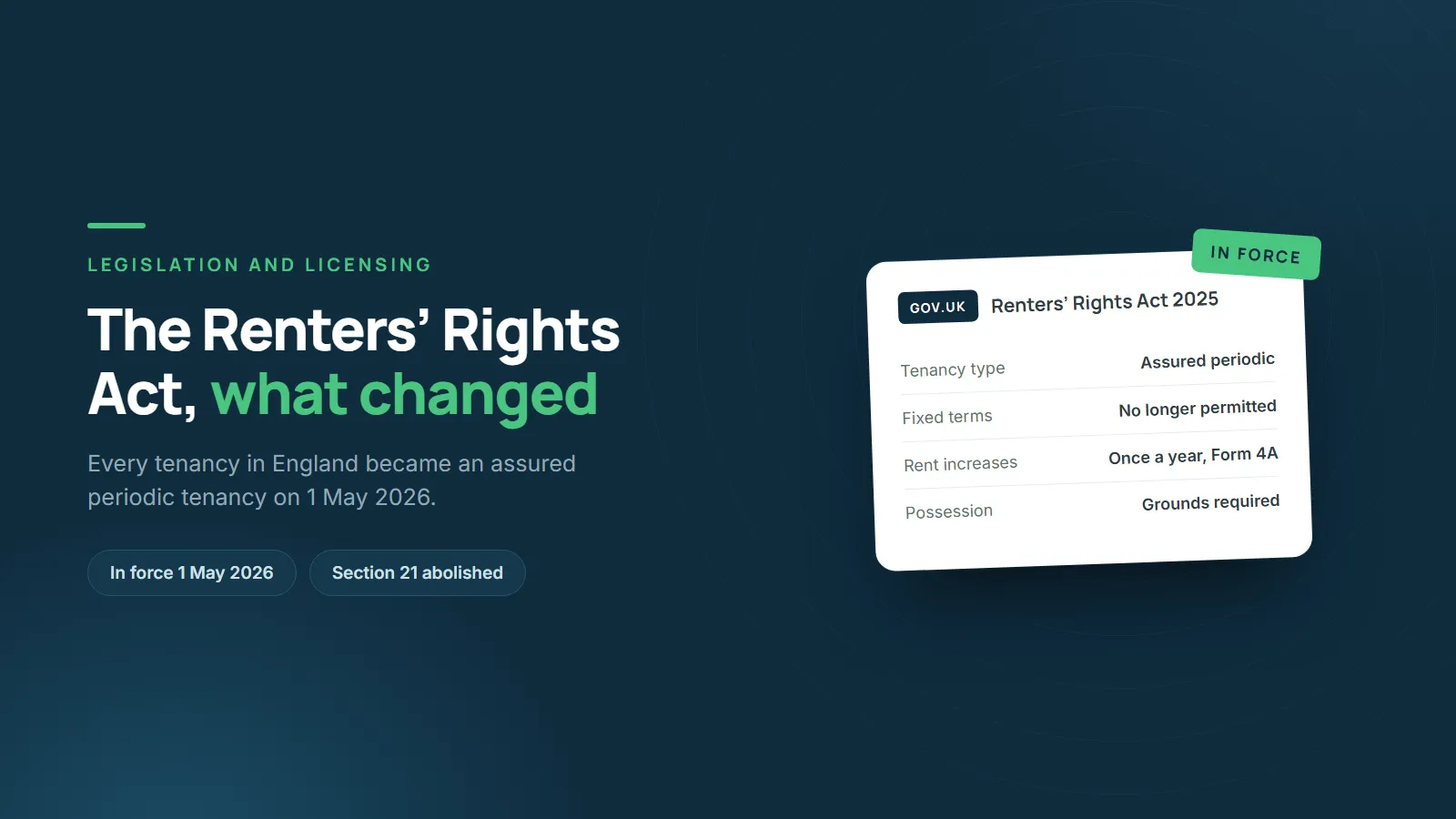
The Renters’ Rights Act 2025 changed private renting in England on 1 May 2026. Section 21 no-fault eviction is abolished, assured shorthold tenancies have become rolling assured periodic tenancies, and possession now needs one of 37 grounds, each with its own notice period.
This is the practical version for landlords. What changed, what you had to do, what it costs if you get it wrong, and the part almost nobody covers, which is what it does to the cover you already hold.
Every figure here comes from the government guidance or the Act itself, and each one is linked so you can check it. The Act applies to England, and Scotland, Wales and Northern Ireland have their own rules.
What Changed on 1 May 2026?
Six things changed at once, and all of them applied to tenancies that already existed rather than only to new lettings.
The headline changes
| Before | From 1 May 2026 |
|---|---|
| Assured shorthold tenancy, often with a fixed term | Assured periodic tenancy, rolling, no end date |
| Section 21 no-fault eviction available | Section 21 abolished, a ground is required |
| Rent rises by agreement or section 13 | Section 13 only, Form 4A, once a year |
| “No DSS” widely used in adverts | Discrimination against benefit claimants prohibited |
| Pets refused at the landlord’s discretion | Requests must be considered, refusal needs a valid reason |
| Rental bidding common in hot markets | The asking rent is advertised, and you cannot accept more |
It applied to existing tenancies too
There was no transition period for the tenancy type itself. Every assured shorthold tenancy became an assured periodic tenancy on the day, whatever the written agreement said.
Your existing agreement still stands
GOV.UK is explicit that the legislation does not require you to change or re-issue an existing written tenancy agreement. Where a clause conflicts with the Act the Act wins, and the rest of the agreement carries on.
What Is the Renters’ Rights Act Information Sheet?
A government PDF that most landlords had to give their existing tenants by 31 May 2026. GOV.UK says you could be fined up to £7,000 for not doing it.
This is the most missed duty of the whole reform, because it was a one-off with a short deadline and no reminder attached to it.
Who had to give it
The duty applied where the tenancy was an assured or assured shorthold tenancy and had a wholly or partly written record of terms. A copy had to go to every tenant named on the agreement.
Lodgers were excluded. Where a letting agent manages the property the agent had to give it to the tenant, even if you gave it as well.
The delivery rule that catches people out
The Information Sheet is only valid when downloaded from the GOV.UK page, and you had to give that exact PDF. There were two acceptable ways to do it.
You could print a hard copy and post it or hand it over. Or you could send the PDF electronically as an attachment, to an email or a text message.
What you could not do is send a link. GOV.UK states plainly that emailing or texting a link to the PDF is not valid, so a landlord who sent the web address did not comply.
If you served notice before 1 May 2026
There is a late route for one group. If you gave a valid section 21 or section 8 notice before 1 May 2026, the tenancy becomes an assured periodic tenancy once that notice lapses or the court process finishes.
You then have one month from that date to give the Information Sheet.
How Do You Get Possession Now?
There are 37 grounds in the government guidance: 26 mandatory and 11 discretionary. The notice period depends entirely on which one you use, and it runs from none at all to 4 months.
If you have seen a figure of 7 grounds quoted, that is wrong. It comes from summaries of the main reasons a landlord might want a property back, not from the schedule itself.
Mandatory or discretionary, and why it matters
These are the section 8 grounds, and they split two ways. On a mandatory ground, once you prove the ground the court must order possession.
On a discretionary ground the court also has to decide that making the order is reasonable. A judge can refuse even where the facts are made out.
The mandatory grounds
| Ground | Reason | Notice period |
|---|---|---|
| 1 | Occupation by landlord or family | 4 months |
| 1A | Sale of the property | 4 months |
| 1B | Sale of a Rent to Buy property | 4 months |
| 2 | Sale by mortgagee | 4 months |
| 2ZA | Possession when a superior lease ends | 4 months |
| 2ZB | Possession when a fixed term superior lease ends | 4 months |
| 2ZC | Possession by a superior landlord | 4 months |
| 2ZD | Possession by a superior landlord, fixed term | 4 months |
| 4 | Student accommodation | 2 weeks |
| 4A | Student property relet to new students | 4 months |
| 5 | Ministers of religion | 2 months |
| 5A | Occupation by an agricultural worker | 2 months |
| 5B | Occupation by a person meeting employment requirements | 2 months |
| 5C | End of employment by the landlord | 2 months |
| 5D | End of employment requirements | 2 months |
| 5E | Occupation as supported accommodation | 4 weeks |
| 5F | Property occupied as supported accommodation | 4 weeks |
| 5G | Tenancy granted for a homelessness duty | 4 weeks |
| 5H | Occupation as stepping stone accommodation | 2 months |
| 6 | Redevelopment | 4 months |
| 6A | Decant accommodation | 4 months |
| 6B | Compliance with enforcement action | 4 months |
| 7 | Death of the tenant | 2 months |
| 7A | Severe antisocial or criminal behaviour | None |
| 7B | No right to rent | 2 weeks |
| 8 | Rent arrears | 4 weeks |
The discretionary grounds
| Ground | Reason | Notice period |
|---|---|---|
| 9 | Suitable alternative accommodation | 2 months |
| 10 | Any rent arrears | 4 weeks |
| 11 | Persistent arrears | 4 weeks |
| 12 | Breach of tenancy | 2 weeks |
| 13 | Deterioration of the property | 2 weeks |
| 14 | Antisocial behaviour | None |
| 14ZA | Rioting | 2 weeks |
| 14A | Domestic abuse | 2 weeks |
| 15 | Deterioration of furniture | 2 weeks |
| 17 | False statement | 2 weeks |
| 18 | Supported accommodation | 4 weeks |
Selling or moving in
Grounds 1 and 1A are the ones most landlords reach for, and both carry 4 months’ notice. Neither can be used to make a tenant leave within the first 12 months of a new tenancy.
You can serve the notice inside that first year. It simply cannot expire before the 12 months has ended.
Worked example: a landlord lets a flat in March and decides in July to sell it. Ground 1A cannot make the tenant leave until the tenancy is 12 months old, so nothing can expire before the following March.
Serving 4 months’ notice in July would expire in November, which is inside the protected period. Serving it in November instead means it expires once the 12 months has run.
Rent arrears
Ground 8 is the mandatory arrears ground, and its threshold is specific. The tenant must owe at least 3 months’ rent where rent is paid monthly, or at least 13 weeks’ rent where it is paid weekly or fortnightly.
The arrears have to be there twice, on the day you serve notice and again at the hearing. A tenant who pays the balance below the threshold before the hearing cannot be evicted on ground 8.
One carve-out is worth knowing. Where the arrears exist because the tenant has not received their Universal Credit, GOV.UK says you will not be able to evict them on this ground.
Worked example: rent is £900 a month and the tenant is £2,900 behind, so ground 8 is available and the landlord serves 4 weeks’ notice. By the hearing the tenant has paid £500, leaving £2,400 owed.
That is under 3 months’ rent, so the mandatory ground fails. Grounds 10 and 11 are still open, but both are discretionary and the judge decides whether possession is reasonable.
Antisocial behaviour has no notice period
Grounds 7A and 14 need no notice period, so you can apply to the court as soon as you have served notice. The court cannot make a possession order for 14 days from the date you gave it.
Deposits now gate possession
A court will only make a possession order where the deposit has been handled properly. An unprotected deposit or missing prescribed information is now a bar to getting the property back, rather than only a penalty in itself.
What Happens When You Go to Court?
You serve a section 8 notice on Form 3A, wait out the notice period, then apply to the court, and there is usually a hearing. GOV.UK warns the case can be dismissed if you have not followed the correct process.
Serving the notice
For an assured periodic tenancy you use a section 8 notice, which is form 3A of the assured tenancy forms. It has to state every ground you are relying on and give the right notice period for them.
You can put your evidence behind it at this stage. GOV.UK gives bank statements showing unpaid rent as its own example.
Try managed payments before you serve
Where the arrears are a Universal Credit or Housing Benefit problem rather than a refusal to pay, you can ask for the rent to be paid to you directly. That is called managed payments, and it goes to the DWP for Universal Credit or to the council for Housing Benefit.
It is often faster than possession and it keeps the tenancy, which matters when the alternative is 4 weeks’ notice and a hearing.
Applying to the court
If the claim is only about rent arrears you can use the Possession Claim Online service. For anything else, including selling the property or a breach of the tenancy, you complete forms N5 and N119 and send them to the court that handles housing possession for your area.
The accelerated route has effectively gone
This is the change landlords notice most. Accelerated possession let a landlord get an order on a section 21 notice without a hearing, and GOV.UK now says you cannot usually apply for one at all.
The exceptions are narrow and closing. They cover valid notices served before 1 May 2026 where the claim was already before the court, and certain cases delayed by a tenant’s breathing space arrangement.
At the hearing
The judge has four options. They can make a possession order, make a money order for what is owed without requiring the tenant to leave, adjourn to a later date, or dismiss the claim.
Bring the paperwork. Your tenant can file a defence form, and the court will send you a copy of it.
If the tenant still does not leave
A possession order is not an eviction. If the date passes and the tenant is still there, you apply for a warrant for possession and a county court bailiff carries it out.
That costs £148 on form N325, or N325A where a suspended order for arrears has been broken. You can apply for up to 6 years after the order was made.
How Do You Increase the Rent?
Once a year, using Form 4A with at least 2 months’ notice, and the tenant can challenge anything above the open market rent.
The process
Rent increases run through the section 13 process only. You complete Form 4A, give it to the tenant, and allow at least 2 months before the new rent starts.
Any clause in an older agreement allowing automatic or negotiated increases no longer works.
Tenants can challenge
A tenant who thinks the proposed rent is above the open market rate can take it to the First-tier Tribunal. That makes the evidence behind your figure worth keeping, because a proposal you cannot support is a proposal that can be reduced.
No bidding
You have to advertise the rent you are asking for. You cannot then accept an offer above it, which removes the bidding that was common in tight markets.
What Does It Mean for Your Insurance?
The cover works the same way, but two of the facts you declared to your insurer are now wrong on almost every policy sold before May 2026.
This is the part other guides skip, and it is the one that costs money at claim time rather than at renewal.
The tenancy type you declared has changed
Most landlord policies ask what kind of tenancy is in place, and most schedules written before May 2026 say assured shorthold. That tenancy type no longer exists.
Tell your insurer the tenancies are assured periodic. It is a change of fact, and an insurer is entitled to ask why a schedule still describes a tenancy the law abolished.
Rent guarantee was built around section 21
Rent guarantee and legal expenses cover are priced on how quickly a landlord can recover a property. They were written when section 21 offered a route needing no ground and 2 months’ notice.
That route has gone, and the common replacements carry 4 months. Check what your policy now covers, how long it pays for, and whether it requires a particular ground or a nominated solicitor.
Longer possession means longer void risk
A possession that used to run on 2 months’ notice now runs on 4 under grounds 1 and 1A. Loss of rent and rent guarantee limits set against the old timetable may not stretch to the new one.
It is worth comparing landlord insurance quotes in the UK at your next renewal, because the declaration you make this year is not the one you made last year.
What Happens If You Get It Wrong?
Penalties run from a civil fine to an unlimited one on conviction, and a rent repayment order can now reach 2 years of rent.
Fines
The Act sets civil penalties for a range of breaches. More serious or repeated conduct can be met with a larger penalty as an alternative to prosecution, and prosecution itself carries an unlimited fine.
Rent repayment orders
A tenant who believes you have committed certain offences can apply to the First-tier Tribunal for a rent repayment order. If the tribunal agrees, you can be ordered to repay rent the tenant has paid you.
Local councils can also apply where the rent was paid through Universal Credit.
Councils have more to work with
Enforcement powers widened alongside the new duties. The practical effect is that the paperwork you keep, from gas certificates to deposit records, is the first thing a council asks for.
What Is Still to Come?
The Act is being commenced in stages, so parts of it are not in force yet. Treat the dates below as something to plan around rather than rules to follow today.
The private rented sector database
Registration is expected to open in stages from December 2026, with active landlords registered through 2027. Once it is running, an unregistered landlord will not be able to obtain possession on most grounds.
The ombudsman, Decent Homes and Awaab’s Law
A private rented sector ombudsman, a Decent Homes Standard for private renting and an extension of Awaab’s Law are all in the Act but need regulations before they take effect. No commencement date is confirmed for them, so any specific year quoted elsewhere is an estimate rather than government policy.
This page is checked against the guidance it cites, and the review date at the top tells you when that last happened.