In this guide 11 sections
- 1 Is Section 21 Still Valid?
- 2 What Happened to a Notice Served Before the Change?
- 3 Are Any Tenancies Still Assured Shorthold Tenancies?
- 4 Why Was Section 21 Abolished?
- 5 What Replaced Section 21?
- 6 How Different Is Possession in Practice?
- 7 What If the Tenant Ignores the Notice?
- 8 How Long Does Possession Take Now?
- 9 What Makes a Possession Claim Fail Now?
- 10 What Did the Change Look Like in Practice?
- 11 What Does the Change Mean for Your Cover?
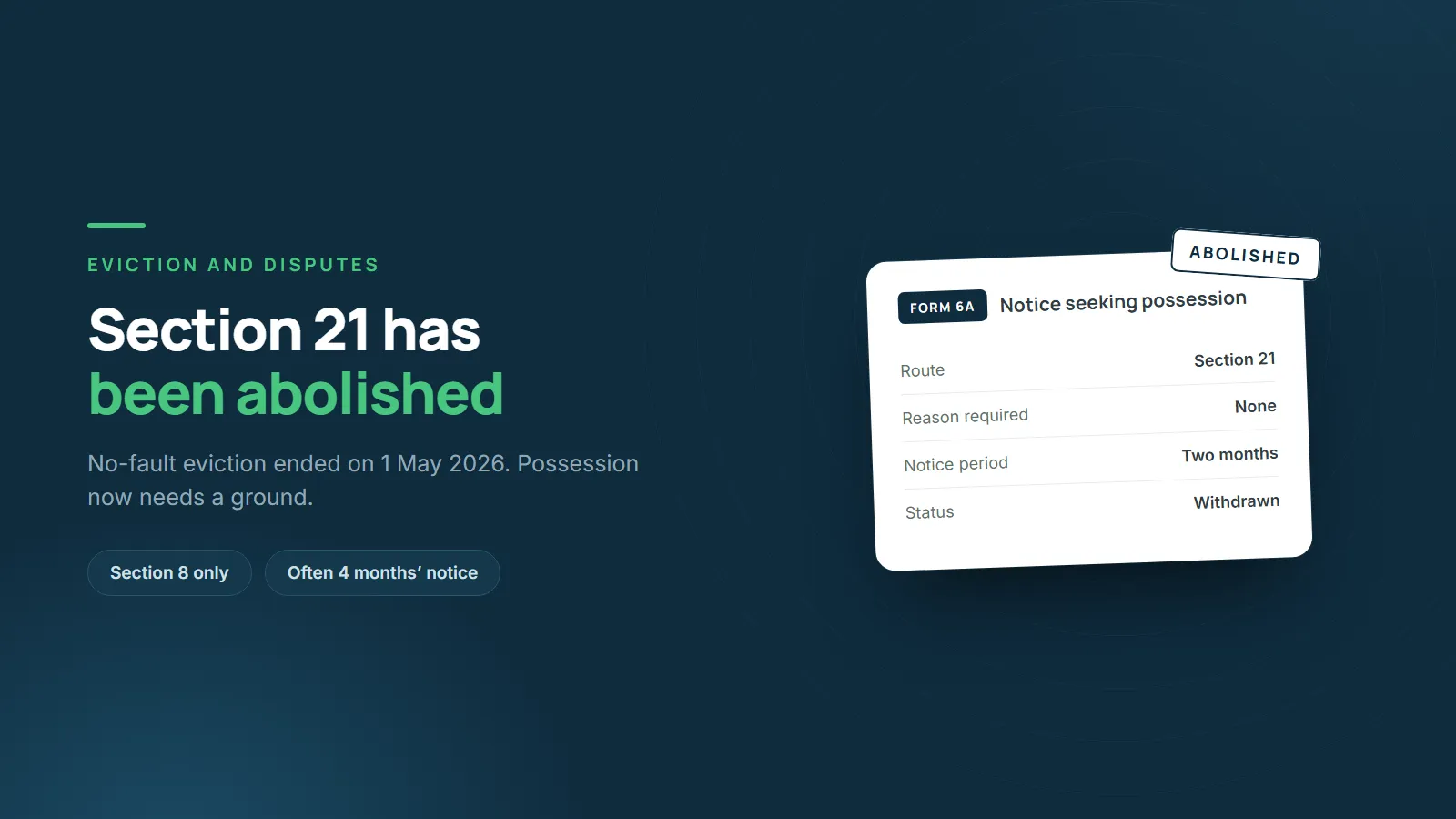
Section 21 was abolished in England on 1 May 2026, and the transitional window for notices already served closed on 31 July 2026. Possession now needs a ground under section 8.
That second date is the one most pages miss, because most of them were written while the window was still open.
If you are holding a section 21 notice today, it can no longer start a claim. If you already issued, your case carries on under the old rules, and your tenancy is still an assured shorthold tenancy.
This page is about where section 21 actually stands. For the route that replaced it, see how to serve a section 8 notice.
Is Section 21 Still Valid?
No. It was not suspended or restricted, it was removed from the statute book, and the window for notices already served has closed.
What was actually repealed
Chapter 2 of Part 1 of the Housing Act 1988 was omitted on 1 May 2026 by the Renters’ Rights Act 2025. That chapter contained assured shorthold tenancies and, with them, section 21.
So this was not a rule change within a surviving framework. The tenancy type and the notice disappeared together.
Abolished is not the same as illegal
Serving a section 21 notice today achieves nothing, because there is no provision for it. That is different from acting unlawfully.
What is unlawful, and always was, is removing a tenant without a court order. That carries a criminal penalty and is unaffected by any of this.
The old two month notice is gone with it
Section 21 needed two months and no reason. Nothing in the new system offers either.
Related: What the Renters’ Rights Act means for landlords
What Happened to a Notice Served Before the Change?
It depended entirely on whether you had asked the court to issue the claim form. Every deadline for doing so has now passed.
The two positions in Schedule 6
Schedule 6 to the Act split section 21 notices in two, and the dividing line was whether a claim form had been requested before 1 May 2026.
Where it had, paragraph 3 says the notice “remains valid until possession proceedings are concluded”. Where it had not, paragraph 4 gave a closing window.
The deadline, and why it has passed
Paragraph 4 set an applicable period: six months from the date the notice was given, or three months from 1 May 2026 where that ended sooner. Three months beginning with 1 May 2026 runs out on 31 July 2026.
So the deadline was whichever of those two came first, and for any notice given from February onwards the answer is 31 July 2026 either way.
| When the notice was given | Deadline to request the claim form | Where that leaves it |
|---|---|---|
| On or before 31 January 2026 | Six months from the date of the notice | Expired |
| 1 February to 30 April 2026 | 31 July 2026 | Expired |
| Claim form already requested in time | None; valid until the case concludes | Can still run |
Whichever branch applied, the latest possible date was 31 July 2026. There is no version of the rule that leaves a usable section 21 notice today.
Notices that specified a longer date
A section 21(4) notice, where the date given had to be more than two months out, ran on a slightly different clock: four months from the date specified in the notice, again capped at three months from 1 May 2026 where that came first.
Same outcome. The cap did the work, and it expired on 31 July 2026.
Accelerated possession went too
The paperwork-only route existed only for section 21. GOV.UK confirms that an accelerated possession application had to be made on or before 31 July 2026 to be issued.
Every possession claim now expects a hearing, which is a real change in how long the process takes and what it costs.
Related: Landlord legal expenses insurance
Are Any Tenancies Still Assured Shorthold Tenancies?
A small number, yes, and it is the detail almost every summary gets wrong.
The blanket statement is not quite true
The common line is that every assured shorthold tenancy converted to an assured tenancy on 1 May 2026. For the overwhelming majority that is right.
But paragraph 3 of Schedule 6 says that where a section 21 claim was already requested, the amendments “do not apply in relation to the tenancy” until the notice ceases to be valid, “and accordingly the tenancy remains an assured shorthold tenancy until then”.
What that means in practice
If you issued a section 21 claim before the deadline and it is still running, you are still dealing with an assured shorthold tenancy under the old law, not an assured periodic tenancy.
The tenancy converts when the proceedings conclude and the notice ceases to be valid. Until then the old framework governs it.
Why it matters
It changes which rules apply to that tenancy while the case runs. If you are in this position, this is a point to take advice on rather than read off a general guide, including this one.
Why Was Section 21 Abolished?
Because a notice needing no reason made it hard to tell a fair ending from a retaliatory one, and the government decided the balance had moved too far.
The argument that won
The case made for abolition was that a tenant who could be removed in two months without a reason was not really free to report disrepair or challenge a rent increase.
Whether or not you accept that, it is the reasoning the Act is built on, and it explains why so much of the new system is about evidence.
What landlords lost
Certainty and speed, mostly. Section 21 gave a predictable timetable that did not depend on proving anything or on a judge agreeing with you.
The replacement is slower, and its outcome depends on records you may not have been keeping.
What landlords kept
More than the headlines suggested. You can still recover the property to sell it or to move in, still act on arrears, still act on antisocial behaviour and breaches of the agreement.
What changed is that each of those now needs a ground, a period and evidence rather than a date.
Does any of this apply outside England?
No. GOV.UK is explicit that its eviction guidance is for England only, and points to separate guidance for Wales, Scotland and Northern Ireland.
Section 21 was never a UK-wide rule, and the Renters’ Rights Act did not change the position anywhere but England. If your property is elsewhere, none of the dates on this page are your dates.
What Replaced Section 21?
Section 8, which requires a ground, evidence and in practice a hearing.
The basic sequence
You pick a ground from Schedule 2 of the Housing Act 1988, serve the prescribed notice giving the period that ground carries, and apply to court if the tenant stays.
The notice is Form 3A for the private rented sector, and it must set out the full statutory wording of each ground rather than its name.
Related: How do you legally increase the rent?
The reason is now in issue
Under section 21 the reason was irrelevant and the paperwork was the case. Under section 8 the reason is the case, and you have to prove it.
That is the single biggest practical difference, and it is why evidence habits now matter more than they used to.
Mandatory and discretionary
On a mandatory ground the court must order possession once the ground is made out. On a discretionary ground it also has to be satisfied that possession is reasonable.
Section 21 had no equivalent of that second test. Roughly a third of the grounds now do.
The grounds are not interchangeable
Each ground carries its own notice period, its own evidence and in several cases its own restrictions. Selling is four months and unavailable in year one; serious arrears is four weeks; antisocial behaviour allows an immediate application.
So the first decision in any possession is which ground the facts actually support, and that decision sets everything after it.
Several grounds can be cited together
You can rely on more than one, and it is often sensible where the facts support each of them. The cost is timing: you must wait for the longest notice period before applying.
The exception is the antisocial behaviour grounds, which let you apply at once even alongside slower grounds.
How Different Is Possession in Practice?
Longer, less certain, and more dependent on your paperwork than on your intentions.
What changed
| Section 21, before 1 May 2026 | Section 8, now | |
|---|---|---|
| A reason required | No | Yes, a ground from Schedule 2 |
| Notice period | Two months | Two weeks to four months, by ground |
| Paperwork-only route | Yes, accelerated possession | No |
| Court tests the reason | No | Yes, and reasonableness on some grounds |
| First 12 months | Available | Grounds 1 and 1A unavailable |
Timelines have stretched
Four months of notice on the common grounds, then a wait for a hearing, then 14 days on the order, then a warrant if it comes to that. Months, not weeks.
The parts you control are the ground you pick and how clean your file is. Very little else.
Selling and moving in
Grounds 1A and 1 cover selling and moving in, both at four months, and neither can be used in the first 12 months of the tenancy.
If you buy a tenanted property intending an early sale with vacant possession, that restriction changes the arithmetic before you exchange.
Related: Compare buy-to-let insurance
Rent arrears
Ground 8 is the mandatory arrears ground and now needs more than three months of arrears on a monthly tenancy, tested both when you serve and at the hearing.
Grounds 10 and 11 cover lesser and persistent arrears but are discretionary, so the court weighs whether possession is reasonable.
What If the Tenant Ignores the Notice?
Nothing happens automatically. A notice has never removed anybody, and under section 8 that is more obviously true than it was.
A notice is a precondition, not an eviction
The notice period expiring does not end the tenancy and does not oblige the tenant to leave. It only makes you eligible to apply to court.
Tenants are routinely advised by councils and charities to stay until a court orders otherwise, partly because leaving early can affect a homelessness application. Expect it rather than read it as bad faith.
What you can and cannot do next
You apply to court for a possession order, and if the order is not complied with you apply for a warrant so bailiffs can carry out the eviction.
What you cannot do is change the locks, remove belongings, cut off services or pressure the tenant out. That is illegal eviction, it is a criminal offence, and it will also sink the possession claim you are running.
The fastest route, realistically
The shortest notice periods are the antisocial behaviour grounds, where you can apply to the court immediately, and the two week grounds. Everything else is four weeks or longer.
There is no longer any route that avoids a hearing, so the court queue sets the pace regardless of the ground you pick.
How Long Does Possession Take Now?
Add the notice period, the wait for a hearing, the time on the order and the wait for a bailiff. Two of those four are outside your control.
The stages, and which ones you set
Only the first line of this is decided by you, and it is decided before you serve.
| Stage | How long | Who controls it |
|---|---|---|
| Notice period | 2 weeks to 4 months, set by the ground | You, by choosing the ground |
| Window to apply to court | Up to 12 months from service | You |
| Wait for a hearing date | Set by the court, varies by area | The court |
| Tenant to leave after an order | 14 days, up to 42 for exceptional hardship | The judge |
| Notice of eviction before a warrant is executed | At least 14 days | Fixed by the rules |
| Bailiff appointment | Depends on the local list | The court |
Anyone quoting you a single national figure for the middle of that table is guessing, because there is no published figure that holds across areas.
Why it is longer than section 21 was
Two months of notice became four on the grounds most landlords use. A paperwork-only route became a hearing in every case.
Those two changes alone move an uncontested case from weeks to months, before anyone argues about anything.
What Makes a Possession Claim Fail Now?
The compliance file, far more often than the merits.
The deposit is now a hard bar
A court can only order possession where the deposit was protected and the prescribed information given, or the deposit returned, or a deposit claim concluded. GOV.UK sets the same three routes out in its overview for landlords.
Under section 21 a deposit failure blocked the notice. It now blocks the possession order itself, on almost every ground.
Related: How to protect a tenancy deposit
Missing certificates
Gas safety record, electrical report, energy certificate and the government information sheet. These are the first things a defence looks for, and the cheapest to have right.
The wrong ground or the wrong period
A notice giving the period for the wrong ground is defective, and on a four month ground that mistake costs four months.
Check the period against the specific ground every time, and where you cite several, work from the longest.
What Did the Change Look Like in Practice?
Two positions that landlords actually found themselves in, and how they resolved.
The notice that ran out of road
A landlord serves a valid section 21 notice on 10 March 2026, expiring in May, intending to deal with the claim afterwards. Nothing about the notice is wrong.
They never request the claim form. Under paragraph 4 the applicable period is the three month cap, ending 31 July 2026, because that falls before six months from the notice.
On 1 August the notice is spent. The tenancy is now an assured periodic tenancy, and getting possession means starting again on a section 8 ground with its own notice period.
The claim that beat the deadline
A second landlord serves in March and asks the court to issue the claim form in June, before the cap.
Paragraph 3 applies. The section 21 notice stays valid until the proceedings conclude, and the tenancy remains an assured shorthold tenancy while the case runs.
The same facts, three months apart in the paperwork, and two entirely different outcomes.
What Does the Change Mean for Your Cover?
Longer possession timelines make the gap between the rent stopping and the property being back a bigger financial exposure than it used to be.
Legal expenses does more work now
Every claim expects a hearing, and defended claims bring counterclaims. Legal expenses cover funds the solicitors, the court fees and often the enforcement, up to the policy limit.
That is a larger job than it was when most possession was a paperwork exercise.
Rent guarantee covers the other half
Legal expenses pays for the case. It does not pay the rent.
On a four month ground plus court time, the missing rent is usually the bigger number of the two.
Related: Rent guarantee insurance
Check the conditions, not just the cover
Rent protection policies commonly require referencing to a standard and prompt notification of arrears. Both are easy to fall foul of when you are busy dealing with the tenant.
Read what the policy requires of you before you need to claim, because that is when the conditions get tested.
Where to start
Comparing landlord insurance cover across the UK with both legal expenses and rent guarantee included is the practical response to a system where possession takes months.
The deposit will not cover it, and under the new rules the deposit can stop the claim outright if it was mishandled.