In this guide 13 sections
- 1 What Is a Section 8 Notice Now?
- 2 Which Grounds Can a Private Landlord Use?
- 3 How Much Notice Must You Give?
- 4 How Do You Complete Form 3A?
- 5 How Do You Serve It and Prove You Did?
- 6 How Long Does the Notice Stay Valid?
- 7 How Do You Apply to Court?
- 8 What Happens at the Hearing?
- 9 What Happens If the Tenant Counterclaims for Disrepair?
- 10 What If the Tenant Still Does Not Leave?
- 11 What Goes Wrong Most Often?
- 12 What Do Failed Notices Look Like?
- 13 What Does the Process Cost You?
A section 8 notice is now the only route to possession in England. You pick a ground, serve Form 3A with the notice period that ground carries, prove you served it, and apply to court if the tenant stays.
Before May 2026 most landlords never touched section 8, because section 21 needed no reason at all. That route is gone, and nothing paperwork-only replaced it.
So this is a process almost every landlord will now go through without practice, on a form most have never seen, where one wrong entry costs months.
This page is about the doing. For what the Act changed and the full table of all the grounds, see what the Renters’ Rights Act means for landlords.
What Is a Section 8 Notice Now?
A notice seeking possession on Form 3A, naming the legal grounds you rely on and giving the notice period those grounds carry.
The form is Form 3A
For the private rented sector in England the notice is Form 3A, currently version 05.26. The social rented sector uses Form 3, which is a different document.
Serving a pre-May 2026 form is an avoidable way to lose four months.
It is a claim you have to prove
Unlike the old no-fault route, the reason is now in issue. The court tests whether the ground is made out, on the evidence you bring.
GOV.UK is blunt about the alternative: a landlord who bypasses the process may be guilty of illegal eviction, which is a criminal offence carrying a prison sentence.
Where the issue is rent, try the alternative first
If your tenant claims Universal Credit or Housing Benefit, you may be able to have the rent paid directly to you through managed payments rather than evicting at all. GOV.UK points landlords there before notice.
A rent increase handled properly is also cheaper than a possession claim handled badly, and the two get confused. See how to legally increase the rent.
Which Grounds Can a Private Landlord Use?
Thirty-one of them. GOV.UK’s notice period list runs to thirty-seven, and six of those are open only to social landlords.
Six of the grounds are not yours
This catches people out, because the notice period guidance lists all of them together without saying who each one is for.
Grounds 1B, 5B, 5D, 5H, 6A and 14A each require the landlord to be a private registered provider of social housing, a relevant social landlord, or a charity. Schedule 2 of the Housing Act 1988 says so inside the ground itself.
That is why the Form 3A legal wording document, which is the private rented sector document, carries 31 grounds rather than 37. If you cannot find your ground’s wording in it, that is usually why.
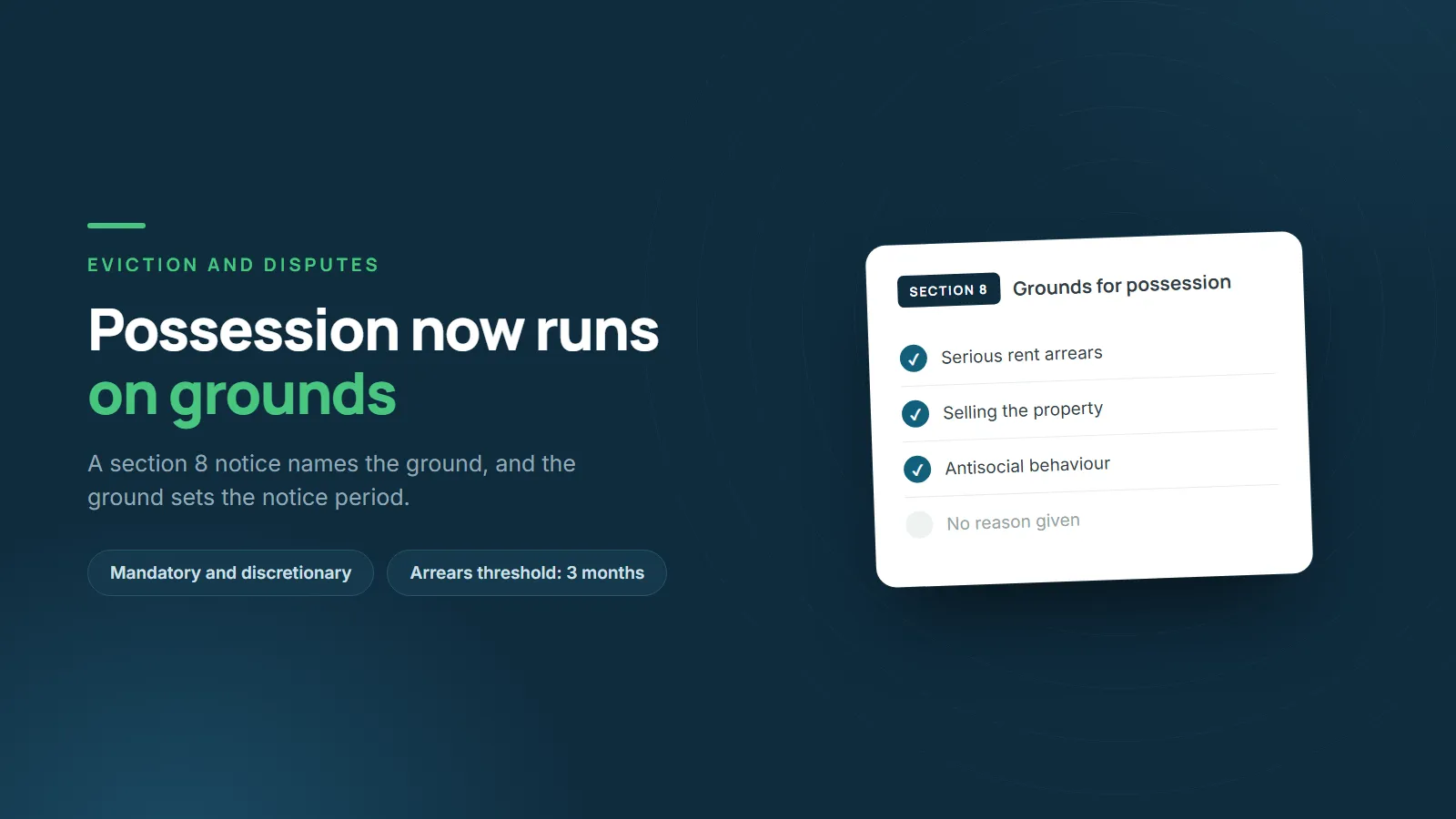
Mandatory and discretionary
The split decides how much room the judge has.
| What the court does | Examples | |
|---|---|---|
| Mandatory | Must order possession once the ground is proved | Serious arrears (8), selling (1A), landlord moving in (1) |
| Discretionary | Orders possession only if it is also reasonable | Some arrears (10), persistent lateness (11), breach (12) |
The grounds most private landlords reach for
Ground 8 for serious arrears, 10 and 11 for lesser or persistent arrears, 1 and 1A for moving in or selling, 12 for breach of the agreement, 13 for deterioration, and 7A or 14 for antisocial behaviour.
Ground 4A covers reletting to students for a new academic year, and it only works where notice was given at the start of the tenancy. If you let to students, check that before you need it.
Related: Student landlord insurance
Ground 8 needs more than 13 weeks of arrears on a weekly or fortnightly tenancy, or more than three months on a monthly one.
The arrears have to be at that level both when you serve and at the hearing. A tenant who pays enough to drop below the threshold the day before removes the mandatory ground, which is why arrears claims are usually pleaded alongside the discretionary ones.
Universal Credit arrears do not count
The Act added a carve-out to Ground 8 that is easy to miss. Where a tenant is entitled to the housing element of Universal Credit, any amount unpaid only because they had not yet received that payment is ignored when you calculate the arrears.
So a tenant three months down purely because of a delayed award may not be in Ground 8 arrears at all. Ground 8 also counts only “rent lawfully due”, which is a second reason the figure you claim and the figure the court uses can differ.
One restriction to check before you start
Grounds 1 and 1A, moving in and selling, cannot be used in the first 12 months of the tenancy.
Related: Rent guarantee insurance
How Much Notice Must You Give?
Anything from none to four months, set entirely by the ground.
The notice periods, by ground
From the GOV.UK guidance on completing Form 3A, with the six social landlord grounds taken out, so what is left is what a private landlord can serve.
| Notice period | Grounds |
|---|---|
| Four months | 1, 1A, 2, 2ZA, 2ZB, 2ZC, 2ZD, 4A, 6, 6B |
| Two months | 5, 5A, 5C, 7, 9 |
| Four weeks | 5E, 5F, 5G, 8, 10, 11, 18 |
| Two weeks | 4, 7B, 12, 13, 14ZA, 15, 17 |
| None, apply at once | 7A, 14 |
The clock starts the day you serve
Not the day you post it, and not the end of a rental period.
Question 2.1 on the form asks for the earliest date you can apply to court, and that is the day after the notice period expires.
Several grounds means the longest period
Cite more than one ground and you wait for the longest before applying. GOV.UK’s own worked example: Ground 8 at four weeks plus Ground 7 at two months, served on 1 June 2026, means you cannot apply until 1 August 2026.
Antisocial behaviour overrides that
Grounds 7A and 14 carry no notice period, and you can apply to court immediately after serving even where you are also relying on other grounds. That exception is easy to miss and worth months.
How Do You Complete Form 3A?
Carefully, and not by ticking boxes. The tick list is optional; the two mandatory questions decide whether the notice is valid.
What each question needs
The form runs to eight pages, but only a handful of entries decide whether it works.
| Question | What it needs | Where it goes wrong |
|---|---|---|
| 1.1 | Every tenant named in full | Missing a joint tenant |
| 1.2 | The address of the let property | Using the tenant postal address |
| 2.1 | The day after the longest notice period expires | Counting from the shortest ground |
| 4.1 | Optional tick boxes, plain English | Treating it as the grounds |
| 4.2 | Full Schedule 2 wording of every ground used | Naming the ground instead |
| 4.3 | Your explanation and evidence, ground by ground | One line with no detail |
| 5.1 | Signature of landlord, licensor or authorised agent | One joint landlord signing without authority |
| 5.7 | An email you monitor, if you give one at all | Not realising it consents to service on you |
Question 4.1 is the trap
It is a plain English list of common grounds with tick boxes. It is explicitly optional, and it does not include every ground.
Ticking a box there is not stating your ground. Landlords have served notices with the tick list complete and the mandatory part blank.
Question 4.2 wants the full statutory wording
This is the part that catches almost everyone. The form’s own note says that for the notice to be valid the tenant must be given notice of the legal grounds, and tells you to insert the full legal wording from Schedule 2 for each ground you use.
Then it says it plainly: do not rely on the name of the ground only.
The wording is long, and the form tells you to continue on a separate sheet if you need to. GOV.UK publishes it separately as Form 3A: legal wording for possession grounds, precisely so you can copy it across.
Question 4.3 is your case, in your own words
Write a heading for each ground and explain why you say it applies, with as much supporting detail as you have. A rent schedule for arrears; dates and incidents for antisocial behaviour.
This is the question a judge reads to see whether you understood your own claim.
Section 5, and the email trap
The notice must be signed by the landlord, licensor, or someone authorised to act. Joint landlords either all sign the additional signatures box or agree that one signs for all.
Note 5.7 repays a second read: if you give an email address, you are agreeing that the tenant and the court may use it to serve documents on you. Use one you actually monitor.
How Do You Serve It and Prove You Did?
Give it to the tenant, keep a copy, and create the record of service on the day rather than reconstructing it later.
Proving service is a separate job from serving
The form tells you to give the notice to the tenant and keep a copy. It does not tell you how to prove it, and that proof is what your court application stands on.
The two ways GOV.UK accepts
Either complete a certificate of service on form N215, or write “served by [your name] on [the date]” on the notice itself.
If the tenant does not leave, you rely on that N215 or endorsed notice when you apply for the possession order.
Doing it on the day takes a minute. Doing it from memory nine months later is a gift to the other side.
Serve every tenant
On a joint tenancy, list all tenants at question 1.1 and serve each of them. A notice that misses one joint tenant is a defect you will hear about at the hearing.
How Long Does the Notice Stay Valid?
Twelve months from the date of service. After that it is dead and you begin again.
The twelve month ceiling
Section 3 of the form says the latest you can apply to court is 12 months from service, after which the notice is no longer valid.
So the notice period is the floor and twelve months the ceiling. Serving early to keep your options open simply burns the window.
Breathing space can extend it
Where the notice is based on rent arrears and the tenant enters a breathing space under the Debt Respite Scheme, validity can be extended by a further eight weeks after that breathing space ends.
It applies where the notice period expires during the breathing space, or where little time is left when it ends.
How Do You Apply to Court?
Possession Claim Online for rent arrears, or forms N5 and N119 on paper for everything else.
The route depends on the ground
The online possession claim service covers claims where you want the property back because the tenant owes rent.
For any other standard possession claim, including selling or a breach of the tenancy agreement, you complete an N5 claim form and an N119 particulars of claim and send them to the court that handles housing possession for your area.
Accelerated possession has gone
The paperwork-only route went with section 21. It survives only for a narrow set of notices given before 1 May 2026, and the deadline for issuing most of those has already passed.
Assume there will be a hearing.
What the court does next
It sends the tenant your claim and documents, sends you a notice of issue carrying your claim number, and sets a hearing date. Keep that claim number, it is the reference for everything afterwards.
The tenant may file a defence form, and you will be sent a copy of it.
Take the whole bundle, in order
The tenancy agreement, the notice, the proof of service, the rent statement, and the compliance certificates.
Paginate it and take three copies: one for the judge, one for the tenant, one for you. A judge reading a loose pile of paper is a judge looking for a reason to adjourn.
What Happens at the Hearing?
A judge tests whether the ground is made out, and on a discretionary ground whether possession is also reasonable.
Four possible outcomes
The judge can make a possession order, make a money order without possession, adjourn to a later date, or dismiss the case.
Dismissal is not rare, and GOV.UK names two everyday causes: you did not follow the correct procedure, or you or your representative did not turn up.
Bring the file, not a summary
The compliance pack decides more of these than the merits do. Deposit position, gas safety record, electrical report, energy certificate and the information sheet.
On the deposit, a court can only order possession where the deposit was protected and the information given, or the deposit returned, or a deposit claim concluded.
Related: How to protect a tenancy deposit
If the tenant defends
The tenant can dispute the ground, the arithmetic, or the procedure. Where the claim is about rent, the defence that does the most damage is a counterclaim about the condition of the property.
What Happens If the Tenant Counterclaims for Disrepair?
Their compensation is set against the arrears you are claiming, and on Ground 8 that can take you below the threshold on the day it is tested.
Why it hits arrears claims hardest
The Civil Procedure Rules describe this squarely. The pre-action protocol for housing conditions claims says a tenant may seek to have compensation for poor conditions “set against money claimed by the landlord”, and names the typical setting: a possession claim for rent arrears.
Ground 8 is tested at the date of the hearing as well as the date of service. So a set-off that reduces the arrears below three months on the hearing date defeats the mandatory ground, however clear the position looked when you served.
What is left if that happens
Grounds 10 and 11, which are discretionary. The court then decides whether possession is reasonable, having just heard evidence that you left the property in poor condition.
That is a materially worse position than the one you started in, and it is reached without the tenant having to prove anything about the arrears themselves.
The duties it is built on
Two implied covenants do most of the work. Section 11 of the Landlord and Tenant Act 1985 requires you to keep the structure and exterior in repair, along with the installations for water, gas, electricity, sanitation, space heating and water heating.
Section 9A of the same Act implies a covenant that the home is fit for human habitation at the start and stays fit throughout the term.
It can arrive with no warning
A tenant bringing a disrepair claim of their own has to follow the pre-action protocol first. A tenant raising the same thing as a counterclaim does not: the protocol expressly does not cover counterclaims and set-offs.
So the first you hear of it may be the defence form, weeks after you issued.
What actually protects you
A dated inspection record before you serve, and another before you issue. Photographs, and the repair history showing what was reported and when you attended.
Reported repairs that were never closed out are what turn a strong arrears claim into a contested one. Landlord legal expenses insurance funds the defence of a counterclaim, and it is far easier to hold before a claim than to arrange during one.
What If the Tenant Still Does Not Leave?
A possession order removes nobody by itself. You apply for a warrant, and county court bailiffs carry out the eviction.
The order gives a date
A tenant will normally have 14 days to leave. Where that would cause exceptional hardship, a judge can extend it to as much as 42 days.
Then the warrant
If they are still there, you apply for a warrant of possession on form N325, which costs £152. County court bailiffs then carry out the eviction.
How long that takes depends on the local bailiff list, and it is the stage with the least published information and the most variation.
The eviction notice adds another 14 days
This one surprises people who think the warrant is the end of it. Under CPR rule 83.8A, a notice of eviction must be delivered to the property not less than 14 days before the warrant is executed.
It applies to High Court writs as well as county court warrants, and it is addressed to everyone the order was made against plus “any other occupiers”. If the eviction does not complete on the day, a further notice of at least 7 days is needed before another attempt.
The High Court route, and why landlords use it
A county court judgment can be enforced in the High Court instead, by High Court enforcement officers rather than county court bailiffs. The draw is speed: bailiff queues are the usual reason a possession order sits unenforced.
The county court may order a transfer under section 42(2) of the County Courts Act 1984, on the application of any party. Once transferred, section 42(5) lets the judgment be enforced as if it were a High Court judgment.
The request goes in on form N293A, a combined certificate of judgment and request for a writ of possession, and sealing the writ costs £82. You also have to certify that the property has not already been vacated.
The enforcement officers charge their own fees on top, which the court fee table above does not cover. And the 14 day eviction notice still applies, so the saving is in the queue rather than in the notice.
Never do it yourself
Changing the locks or pressuring a tenant out is illegal eviction, a criminal offence carrying a prison sentence. The only lawful exception is an excluded tenancy or licence, which means a lodger sharing with you, not an ordinary let.
What Goes Wrong Most Often?
Timing, wording, and a gap in the file. All three are unforced.
Applying to court too early
With several grounds people count from the shortest. The earliest application date is the day after the longest period expires.
Naming a ground instead of quoting it
Question 4.2 wants the statutory wording. “Ground 8, rent arrears” is a name, not a ground, and the form warns against exactly that.
Picking a ground the facts do not reach
Ground 8 on eleven weeks of arrears, or selling in month nine of a tenancy. Match the ground to the facts as they stand on the day you serve.
A compliance gap
A deposit protected late, or a missing gas certificate. These are the first things a defence looks for, and the deposit rules can bar possession outright.
What Do Failed Notices Look Like?
Both of these are failures, because failures are where this process actually gets tested.
Counted from the wrong ground
A landlord serves on 1 June 2026 citing Ground 8 for arrears and Ground 1A because they also intend to sell. Ground 8 carries four weeks, Ground 1A four months.
They apply to court on 1 July, reading the four weeks as the operative period. The claim is premature: the earliest date was the day after the four month period expired, in October.
The notice itself survives, since it runs twelve months, but they have lost the fee and the hearing date, and the tenant now knows the sale is coming.
Ticked the box, left 4.2 blank
A landlord uses Form 3A for a tenant in serious arrears. They tick the 4.1 box for arrears over three months, write a clear explanation at 4.3, sign it and serve it.
Question 4.2 is empty, because 4.1 looked like it had already done that job.
At the hearing the tenant’s adviser points out that 4.1 is optional, 4.2 is mandatory, and the tenant was never given the legal grounds. The notice is defective, the claim goes, and more arrears accrue before a fresh notice can even be served.
What Does the Process Cost You?
£567 in court fees to get to an enforced eviction, and that is the small part. The cost is the months of lost rent.
What the court charges
These come from Schedule 1 to the Civil Proceedings Fees Order 2008, as substituted on 13 July 2026 by the Court and Tribunal Fees (Miscellaneous Amendments) Order 2026. Figures published before that date are out of date, and the older £404 issue fee is still widely quoted.
| Step | Fee | Where it comes from |
|---|---|---|
| Starting a possession claim in the county court | £415 | Sch 1, para 1.4(b) |
| Starting one in the High Court | £559 | Sch 1, para 1.4(a) |
| Warrant of possession, for county court bailiffs | £152 | Sch 1, para 8.6 |
| Sealing a writ of possession, for High Court enforcement | £82 | Sch 1, para 7.1 |
| Applying to suspend a warrant | £16 | Sch 1, para 2.7 |
So the ordinary county court route to an enforced eviction is £415 to issue and £152 to enforce, £567 in court fees. Solicitors, and any enforcement agent above the bailiff, are on top of that.
Claiming the arrears as well costs nothing extra
The Order says that where a money claim is additional or alternative to a claim for recovery of land, only the possession fee is payable.
So adding the rent arrears to a possession claim does not add a second issue fee, whatever the arrears come to. There is no fee reason to leave the money claim out.
How long the whole thing takes
Two of these stages have no published national figure, because they depend on your local court and bailiff capacity. Pretending otherwise is how landlords end up planning around a number that was never real.
| Stage | How long |
|---|---|
| Notice period | 2 weeks to 4 months, set by the ground |
| Window to apply to court | Up to 12 months from service |
| Wait for a hearing date | Set by the court, varies by area |
| Tenant to leave after an order | 14 days, up to 42 for exceptional hardship |
| Warrant and bailiff appointment | Depends on the local bailiff list |
Only the first and the fourth are in your control, and only the first is decided before you serve.
Rent keeps not arriving
On a four month ground, plus time to a hearing, plus a warrant if it comes to that, an uncontested case runs many months. The mortgage does not pause for any of it.
At £1,200 a month, six months of an empty rent account is £7,200 before a solicitor bills anything. Five weeks of deposit does not touch that.
Two different products
Rent guarantee replaces the income. Legal expenses funds the solicitors, the court fees and often the enforcement, up to the policy limit.
Most landlords in a possession claim need both, and they are bought separately.
Comparing landlord insurance quotes in the UK with both included is the part of this you can do today, while nothing has gone wrong.
Related: What happened to Section 21 notices?
Take advice before serving, not after
An hour with a housing solicitor before the notice goes out is cheaper than a wasted four months. Most legal expenses policies include a helpline that will do exactly that.