In this guide 10 sections
- 1 What Does the Law Require?
- 2 When Is the Next Check Due?
- 3 What Must the Record Contain?
- 4 Who Must Get a Copy, and When?
- 5 How Long Must You Keep the Record?
- 6 Does a Missing Certificate Still Block Eviction?
- 7 Are Carbon Monoxide Alarms Part of This?
- 8 What If the Tenant Will Not Let the Engineer In?
- 9 What Do Gas Safety Failures Look Like?
- 10 What Does It Mean for Your Cover?
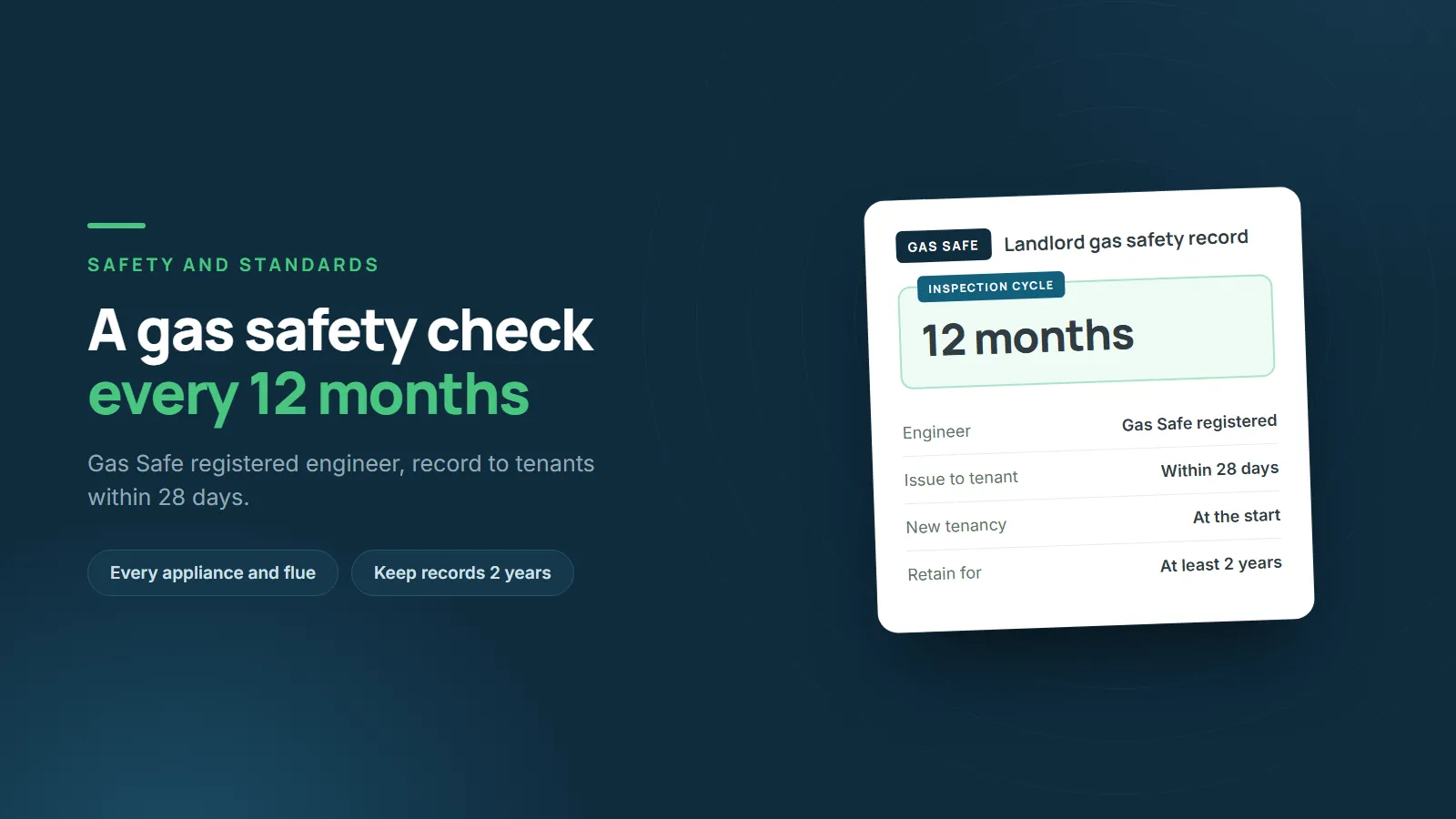
You must have every gas appliance and flue checked at intervals of no more than 12 months by a Gas Safe registered engineer, keep a record with nine specified items, and give the tenant a copy within 28 days.
That much is well known. Three things about it are routinely described wrongly, and all three are checkable in the regulations.
The deadline does not move when you check early, and records are kept until two further checks rather than for two years.
And the rule that a missing certificate blocks eviction was a section 21 rule, which no longer applies to private assured tenancies.
What Does the Law Require?
A safety check at least every 12 months, done by an approved engineer, recorded properly, and given to the tenant.
The core duties
Regulation 36 of the Gas Safety (Installation and Use) Regulations 1998 requires each appliance and flue to be checked within 12 months of installation and at intervals of not more than 12 months since the last check.
For a new lease, the appliances must have been checked within the 12 months before the lease commences.
Only an approved engineer
Regulation 36(4) requires the check to be carried out by, or by an employee of, a person approved by the Health and Safety Executive for these regulations.
In practice that is a Gas Safe registered engineer, and the record has to carry the registration number of the individual or their employer. A check by anyone else is not a check for these purposes.
It applies to the appliances you are responsible for
The duty extends to the relevant gas fittings and flues in the property. A tenant’s own appliance that you did not provide is not yours to check, although the flue serving it may still be.
Where that line sits is worth settling with the engineer rather than assuming, because the record has to describe and locate each appliance checked.
The same question arises on damp and ventilation, where responsibility splits between the fabric of the building and how it is used.
Related: Damp and mould responsibility
Related: Landlord home emergency cover
When Is the Next Check Due?
Twelve months from the deadline date, not twelve months from the day the engineer actually came. That distinction is regulation 36A and it saves landlords a fortnight a year.
Checking early does not move the date
Regulation 36A(1) says a check completed within the two months ending with the deadline date is treated as having been made on the deadline date.
So if your deadline is 30 June and the engineer attends on 5 May, the next deadline is still 30 June. Without that rule the anniversary would creep earlier every year and you would eventually lose a month.
The one-off discretion to run late
Regulation 36A(2) lets you check within the two months beginning with the deadline date instead. That sounds like a grace period and it is not.
It can be used only once for each appliance, and only to align that appliance’s deadline with another appliance’s deadline in the same property. Use it for convenience and you are simply late.
What that means in practice
| Situation | Effect on the deadline |
|---|---|
| Check done in the 2 months before the deadline | Treated as done on the deadline date; anniversary unchanged |
| Check done on the deadline date | Anniversary unchanged |
| Check done in the 2 months after, to align appliances | Permitted once per appliance, for that purpose only |
| Check done late for any other reason | A breach, and the record will show it |
What Must the Record Contain?
Nine specific items. A record missing one of them is not the record the regulations require.
The required information
Regulation 36(3)(c) lists them.
| # | Item |
|---|---|
| 1 | The date the appliance or flue was checked |
| 2 | The address of the premises |
| 3 | The name and address of the landlord, or the agent |
| 4 | A description and the location of each appliance or flue checked |
| 5 | Any safety defect identified |
| 6 | Any remedial action taken |
| 7 | Confirmation the check complies with regulation 36(9) |
| 8 | The name and signature of the individual who carried out the check |
| 9 | The registration number of that individual or their employer |
Read it when it arrives
A defect noted with no remedial action recorded against it is an open item, in writing, with your name on it. That is the single most useful thing to look for when the record comes through.
Sign it off properly and the record works for you. File it unread and it becomes evidence against you.
Who Must Get a Copy, and When?
Existing tenants within 28 days, new tenants before they move in, with two display alternatives for narrow cases.
The two deadlines
Regulation 36(6) sets both: a copy of the record to each existing tenant within 28 days of the check, and a copy of the last record to any new tenant before that tenant occupies the premises.
The second is the one that gets missed in a rushed move-in, and it is the harder one to fix afterwards because the moment has passed.
When you can display instead of give
For a tenant whose right to occupy is for 28 days or less, the record may be prominently displayed in the property instead of given.
Separately, regulation 36(7) covers premises where there is no relevant gas appliance in the room the tenant occupies. There you may display a copy with a statement that the tenant can have their own copy on request, and you must then provide it as soon as practicable.
The deadlines in one place
| Who | By when | Alternative |
|---|---|---|
| An existing tenant | Within 28 days of the check | None |
| A new tenant | Before they occupy the premises | None |
| A tenant occupying for 28 days or less | Before occupation | Display it prominently instead |
| A tenant with no gas appliance in their room | As above | Display it, with a statement that they can request a copy |
| The council, for a licensed HMO | Annually | None |
Keep proof you gave it
The duty is to give the copy, so the useful record is of the giving. Email it and keep the sent item, or hand it over and note the date.
Related: HMO licensing
HMOs have an extra step
In a licensed HMO you also send the council an updated gas safety certificate every year. That is a licence condition on top of the regulation, and it is a separate act from giving the tenant their copy.
How Long Must You Keep the Record?
Until there have been two further checks of that appliance. The familiar two year rule is not the general rule.
What the regulation says
Regulation 36(3)(c) requires the record to be retained until there have been two further checks of the appliance or flue.
The two year period applies to a different case: where an appliance or flue has been removed from the premises, the record is kept for two years from the date of its last check.
Why the distinction matters
On an annual cycle, two further checks is roughly two years, which is presumably why the shorthand took hold. But if a check is done early or the cycle slips, the two are not the same thing.
Keeping everything is simpler than working out which rule applies, and storage is free.
Does a Missing Certificate Still Block Eviction?
Not automatically, and this is the point most guidance has not caught up with.
The rule attached to section 21
The 2015 prescribed requirements regulations tied a section 21 notice to the gas safety record and the energy performance certificate. No record given, no valid section 21.
Those regulations were revoked in relation to private assured tenancies on 1 May 2026, alongside the abolition of section 21 itself. There are savings for tenancies still running under the old rules.
Related: What happened to Section 21 notices?
What has not changed
The automatic bar has gone. The consequences have not.
Failing to check is a criminal matter under the regulations, enforced by the Health and Safety Executive, and that is unaffected by anything in the Renters’ Rights Act.
And it still damages a possession claim
On a discretionary ground the court decides whether possession is reasonable, having heard whatever the tenant says about how the property was run. A lapsed gas check is exactly the material that argument is built from.
It also feeds a disrepair counterclaim, which on an arrears claim can reduce the arrears below the mandatory threshold.
Related: Landlord legal expenses insurance
Related: Section 8 grounds for possession
Are Carbon Monoxide Alarms Part of This?
No. They come from separate regulations, and the trigger is narrower than most landlords think.
What the alarm rules require
The 2015 alarm regulations require a smoke alarm on each storey containing a room used wholly or partly as living accommodation, and a carbon monoxide alarm in any such room containing a fixed combustion appliance.
Both must be checked and found in working order on the day a new tenancy begins.
A gas cooker does not trigger it
The carbon monoxide duty applies to a fixed combustion appliance other than a gas cooker. That exclusion is on the face of the regulation and it is the detail most often stated wrongly.
A gas boiler, a gas fire or a solid fuel stove brings the duty. A gas hob on its own does not.
Bathrooms count as rooms
Regulation 4(2) treats a bathroom or lavatory as a room used as living accommodation. A bathroom with a fixed combustion appliance in it therefore needs an alarm, which is easy to overlook.
Repair on report
Since October 2022, where a tenant reports that a prescribed alarm is not working, you must repair or replace it. The duty is triggered by the report, so how you log tenant reports is part of complying.
What If the Tenant Will Not Let the Engineer In?
The duty stays with you, so the answer is a documented trail of reasonable attempts rather than a legal shortcut.
There is no self-help route
You cannot force entry, and you should not try. What you can do is show that you took the duty seriously and were prevented.
Build the trail as you go
Written requests with dates and proposed times, and engineer attendance notes recording no access.
Then a follow-up in a different medium after each failure.
Three unanswered texts are not the same thing as three letters, two attended visits and a recorded delivery. The second set is what an inspector or a judge reads as reasonable.
Do not let it lapse quietly
An expired check with no file behind it looks like neglect. An expired check with a thick file of attempts looks like an access problem, which is a different conversation entirely.
What Do Gas Safety Failures Look Like?
Both of these are failures of paperwork rather than of plumbing, which is how most of them happen.
The certificate nobody handed over
A landlord has the annual check done on time, every year, by a Gas Safe engineer. The appliances are sound and the records are filed neatly.
A new tenant moves in and, in the rush of a same-week let, nobody gives them the last record before they occupy.
Two years later there is a dispute about the condition of the property. The tenant’s adviser asks when they were given the gas record, and the answer is never.
The appliances were always safe and the duty was still breached, which is the kind of detail that colours everything else a judge hears.
The deadline that drifted
A landlord books the check whenever the engineer has a slot, usually a few weeks early, and treats each check date as the start of the next 12 months.
Over six years the anniversary walks forward from June to September. Believing they are early, they are eventually checking more than 12 months after the previous deadline.
Regulation 36A existed the whole time and would have held the date at June. The drift was avoidable and, on the face of the records, it reads as a series of late checks.
What Does It Mean for Your Cover?
A valid gas safety record is frequently a policy condition, so the same lapse can cost you twice.
The condition is usually explicit
Landlord policies commonly require compliance with statutory safety obligations, and gas is the one most often named. A fire or escape of gas claim on a property with a lapsed check is an obvious place for an insurer to look.
It overlaps with the licence conditions too
In a licensed HMO the same certificate satisfies a licence condition and a policy condition. One missed appointment can therefore breach both at once.
Related: Compare buy-to-let insurance
Where to start
Diarise the deadline date rather than the check date, because regulation 36A means those are different things. Then make sure the cover matches the property as it actually is.
Comparing UK landlord insurance providers is the easy part. Getting the deadline right is the part that decides whether the cover responds.