In this guide 9 sections
- 1 What Does a Subsidence Crack Look Like?
- 2 What Can Be Mistaken for Subsidence?
- 3 What Causes Subsidence?
- 4 What Are Heave and Landslip?
- 5 What Should You Do If a Tenant Reports Cracks?
- 6 What Does It Mean for the Tenancy?
- 7 Can You Still Insure a Property That Has Moved?
- 8 What Does Subsidence Do to a Claim?
- 9 How Do You Reduce the Risk?
Subsidence is the ground beneath a building sinking and pulling the foundations down with it. Most cracks in most houses are not subsidence, and telling the difference is the whole job.
The Association of British Insurers gives a usable test, and it is more specific than the advice you usually see.
For a let property there is a second question layered on top: what happens to the tenancy, and to the rent, while anyone works out what is going on.
What Does a Subsidence Crack Look Like?
Diagonal, wider at the top than the bottom, thicker than a 10 pence coin, and usually near a door or a window.
The ABI test
The ABI says the first sign is usually cracking in internal plasterwork or external brickwork, and that subsidence cracks are distinctive.
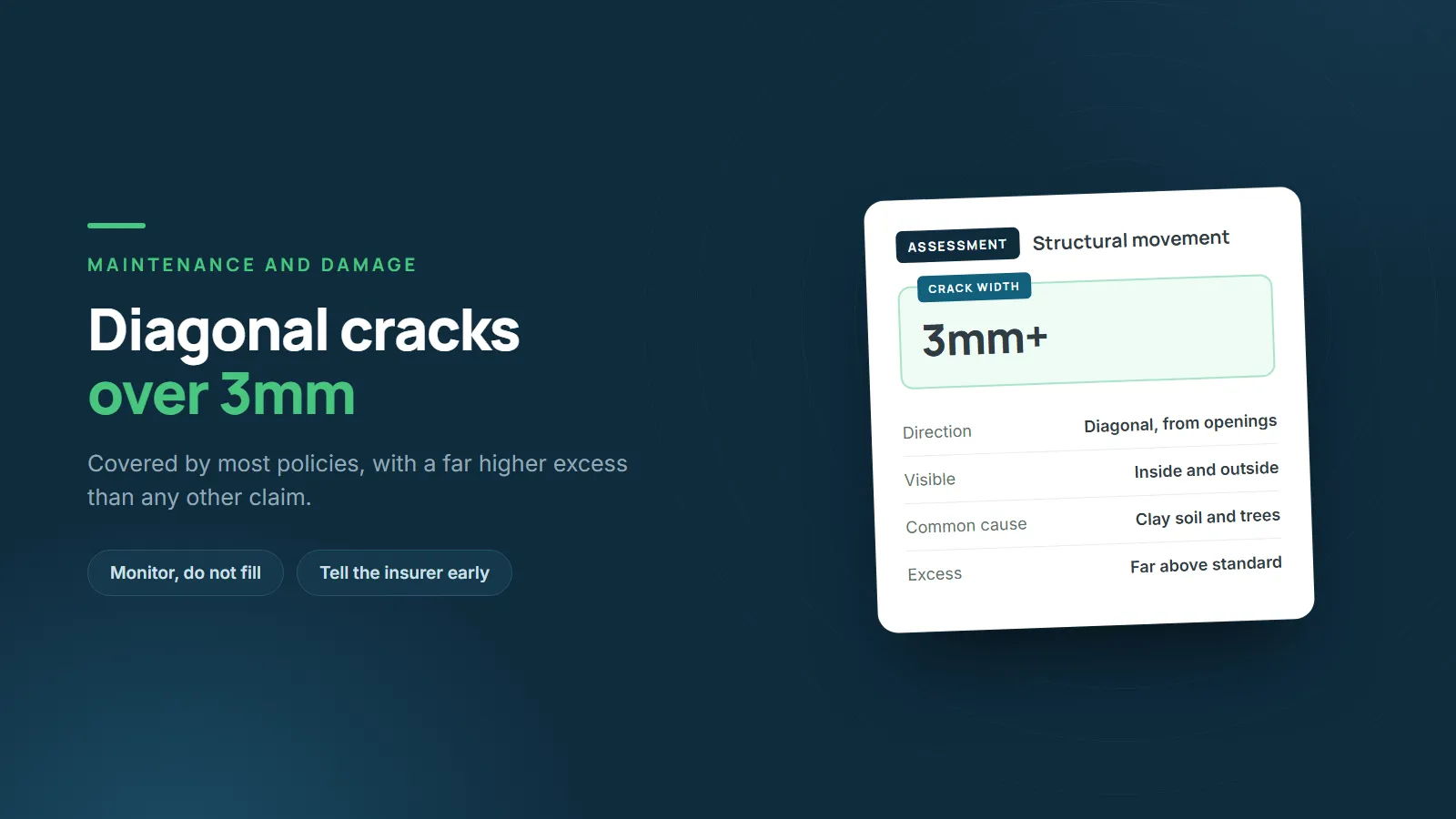
They appear suddenly, often after a long dry spell, and they are diagonal, wider at the top than at the bottom, thicker than a 10 pence coin, and found around doors and windows.
The other signs
Doors and windows sticking for no obvious reason. Wallpaper ripping or crinkling where damp is not the cause.
Those two matter for a let property because they are the things a tenant notices and mentions in passing, long before anyone looks at a wall.
One crack is not a diagnosis
The ABI is clear that a crack does not necessarily mean subsidence, and that although many properties crack from time to time, only rarely is subsidence the cause.
That cuts both ways. It is a reason not to panic, and a reason not to dismiss the first report without looking.
What Can Be Mistaken for Subsidence?
Thermal movement, settlement and drying plaster. All three are common, and all three look alarming to someone who has just read about subsidence.
The three usual suspects
| What it is | Why it cracks |
|---|---|
| Thermal and humidity movement | Buildings shrink and swell with temperature and humidity, typically cracking where walls meet ceilings |
| Settlement | New homes and recent extensions settle under their own weight |
| Drying plaster | Fine cracks are common in freshly plastered walls as they dry |
How they look different
The ABI describes cracks from these causes as usually uniform in width and narrow, from hairline to around 3mm, and says they can be dealt with in routine maintenance or redecoration.
So the shape matters as much as the size. A tapering diagonal crack wider at the top is a different thing from an even hairline crack of the same length.
Settlement is not subsidence
Settlement is downward movement as a new structure beds into the ground under its own weight. Subsidence is the ground itself giving way beneath an established building.
The distinction matters for insurance, because policies cover subsidence and generally do not cover settlement of a new structure.
What Causes Subsidence?
Four things, according to the ABI, and the first two account for most of it in England.
The four causes
| Cause | How it works |
|---|---|
| Soil type | Clay soils shrink, crack and shift in hot dry weather depending on water content |
| Trees and shrubs | Near foundations on clay, some species draw out much more water and dry the soil |
| Local mining activity | Old mines, quarries and pit sites can become unstable if fill material collapses |
| Leaking drains and waterways | Wash away or soften soil; sandy and gravelly soils are the most vulnerable |
Why dry summers matter
Clay shrinks as it loses moisture, so subsidence claims cluster after prolonged dry weather. A property that has stood for a century can move in a single hot summer.
That is also why cracks that appear suddenly in late summer deserve more attention than the same crack appearing in February.
The drains point is the one landlords can act on
A leaking drain softening the ground under a corner of the building is a maintenance failure with a large consequence. It is also the cause most likely to be found and fixed cheaply if someone looks early.
Related: Damp and mould responsibility
What Are Heave and Landslip?
The two perils insurers name alongside subsidence, because they are different kinds of ground movement and the distinction changes the response.
Three movements, one policy heading
Buildings policies almost always list subsidence, heave and landslip together. They are not the same thing and a claim turns on which one you have.
| Movement | Direction | Typical trigger |
|---|---|---|
| Subsidence | The ground sinks beneath the building | Clay drying out, trees, leaking drains, old workings |
| Heave | The ground swells and pushes upward | Clay taking up water again, often after a tree is removed |
| Landslip | Sloping ground moves down the slope | Saturation, undercutting, loss of support |
Heave is the one landlords cause
Of the three, heave is the one most often triggered by a well-meant decision. Take out the mature tree that was drying the clay and the soil rehydrates and expands.
That is why the advice on trees is to get specialist advice first, and why the cheapest-looking fix is the one to be most careful about.
Check the excess applies to all three
Where a policy groups the three, the higher excess usually attaches to the whole heading rather than to subsidence alone.
Worth reading in the schedule, because a heave claim after tree work is not a rare scenario.
What Should You Do If a Tenant Reports Cracks?
Look, record, and get advice before you commit to a theory or a contractor.
Go and see it
Photograph the crack with something for scale, note the date, and note the weather that preceded it. A 10 pence coin in the photograph is not a joke, it is the ABI’s own yardstick.
Then look for the other signs: sticking doors and windows, and cracks that run through more than one element.
Tell the insurer before you tell a builder
A subsidence claim is investigated by the insurer, usually with a structural engineer and often with monitoring over months. Work commissioned before that can complicate the claim.
The instinct to get a builder in and make it look better is the wrong one here.
Do not remove the tree
Removing a mature tree from clay soil lets the ground take up water and swell back, which is heave, and heave can do more damage than the original subsidence.
The ABI recommends seeking professional advice from a tree specialist before undertaking any work. That advice exists because the obvious fix is sometimes the expensive mistake.
Keep the tenant informed
Investigation is slow and intrusive, and a tenant who hears nothing for six weeks fills the silence themselves. Tell them what is happening and roughly when.
What Does It Mean for the Tenancy?
That depends on whether the property stays habitable, and that question should be settled early rather than assumed.
Access for investigation
Monitoring and investigation need access, sometimes repeatedly and sometimes with excavation outside. Give proper notice, agree times, and put the arrangements in writing.
If the property becomes unlettable
Where an insured event makes the property impossible to live in, loss of rent cover is what replaces the income. It is not the same as rent guarantee, which covers a tenant who does not pay.
Check which you actually hold, because subsidence works are exactly the scenario people discover they assumed the wrong one.
Related: Loss of rent insurance
If the tenant stays
Most subsidence work is done around an occupied property, over a long period. The practical issues are noise, access and disruption rather than rehousing.
A tenant living through months of monitoring is a tenant whose goodwill is worth maintaining, particularly since possession is slower and harder than it used to be.
Related: Section 8 grounds for possession
Can You Still Insure a Property That Has Moved?
Usually, but not always on the same terms, and the market narrows.
What the ABI says about continuing cover
ABI members are committed to working with policyholders to manage ongoing subsidence risk and maintain cover, though the ABI acknowledges there may be circumstances where continuing cover is not possible.
So the first conversation is with your existing insurer, not the open market.
Moving to a new insurer
If the property is still at risk, the ABI says you may pay a higher premium than other owners and the policy may be subject to different terms and conditions.
Where there is a history of subsidence damage and you want to change provider, the ABI’s advice is to go through a broker via the British Insurance Brokers’ Association for specialist help rather than shopping the mainstream market.
Related: Non-standard landlord insurance
The eight week rule
This is the detail worth knowing before you switch. Under the ABI’s subsidence claim handling agreement, if you change insurer and then discover subsidence damage, the agreement decides whether the previous or the current insurer handles the claim.
It turns on the time between switching, discovering the damage and notifying. Where notification falls within eight weeks of changing provider, the previous insurer handles the claim.
Declare it, always
A subsidence history is material to any insurer. Not disclosing it risks the cover itself, which is a far worse outcome than a loaded premium.
The same applies to cracks under investigation that have not yet been diagnosed.
What Does Subsidence Do to a Claim?
It is covered by buildings insurance as standard, but it is the peril insurers treat most carefully.
Expect a higher excess
Subsidence normally carries its own excess, set higher than the excess for other perils on the same policy. Check the figure in your schedule rather than assuming it matches the rest.
Expect a long claim
Monitoring across seasons is normal, because the point is to see whether the building is still moving. A claim measured in months rather than weeks is not a sign anything has gone wrong.
Check what is not included
Boundary walls, gates, fences, paths, drives and patios are commonly excluded from subsidence cover even where the house itself is covered.
On a let property those are the parts a tenant uses daily, so it is worth knowing which side of the line they sit before anything moves.
Related: Compare buy-to-let insurance
How Do You Reduce the Risk?
Manage water and manage trees. The ABI’s own prevention advice comes down to those two.
Keep water where it belongs
Maintain gutters, pipes and plumbing to avoid leaks. A blocked downpipe discharging against a wall for a winter is a cheap fault with an expensive ending.
On a let property that means an inspection regime rather than waiting to be told.
An empty property is worse again, because nobody is there to notice a leak at all.
Related: Unoccupied property insurance
Manage planting near the building
Trees or large shrubs close to the house, garage or outbuildings can dry clay soils significantly, so they may need managing. Take specialist advice before doing the work rather than after.
Know your ground
Clay soil areas carry more risk, and that is knowable before you buy rather than after. If you are building a portfolio in a clay area, it is a factor in the buying decision as much as in the insurance.
Related: Portfolio landlord insurance
Comparing UK landlord property insurance on an accurate description of the property, including any history of movement, is the part that determines whether the cover responds when it matters.