In this guide 10 sections
- 1 Is Buy to Let Still Worth It in 2026?
- 2 What Return Does a Buy to Let Make?
- 3 Where Are the Highest Yields?
- 4 Which Property Type Pays Best?
- 5 What Does It Cost to Buy?
- 6 What Does Tax Take?
- 7 What Does One Real Purchase Look Like?
- 8 How Should You Stress Test a Purchase?
- 9 What Else Has Changed?
- 10 Who Should Not Buy to Let?
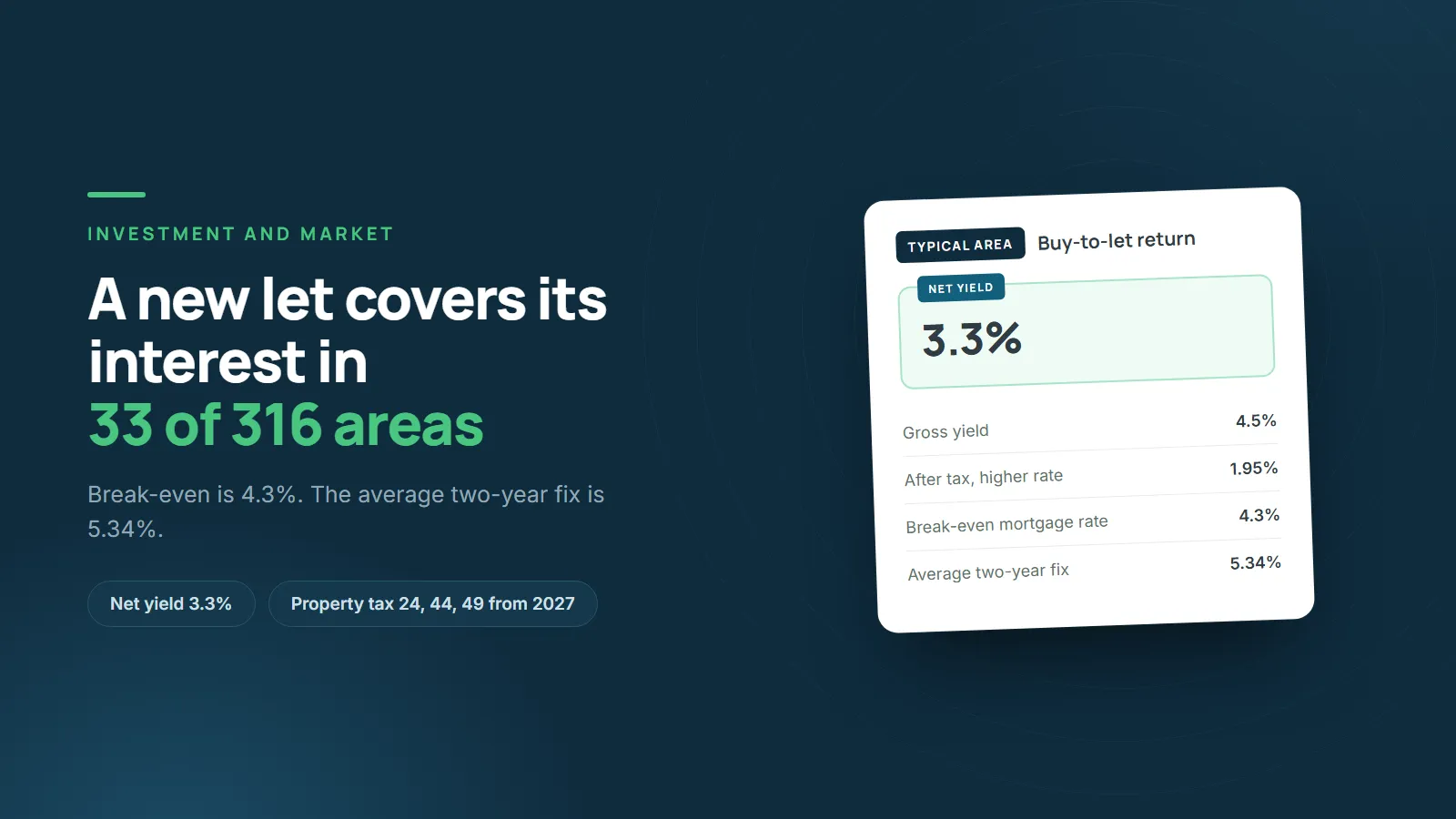
At October 2026 prices and rents, a newly bought let covers its mortgage interest in 33 of 316 council areas in England and Wales. In the other 283 it does not.
That number explains why the buy-to-let question has changed shape. For twenty years the argument was about which property to buy.
It is now about whether the arithmetic works at all. For a mortgaged purchase at today’s prices, across most of the country, it does not.
It still works for some buyers, in some places, in some structures. This sets out which, with the figures and the method, so the conclusion can be checked rather than taken on trust.
Is Buy to Let Still Worth It in 2026?
The break-even mortgage rate on the average let in England and Wales is 4.3%. The average two-year buy-to-let fix is 5.34%.
Break-even here means the rate at which the rent, after running costs and before tax, exactly covers the interest. Rightmove put the average two-year fix at 5.34% in October 2026, a full percentage point above it.
That gap produces the figure at the top of this page. Thirty-three areas where a new purchase covers its own interest, and 283 where it does not.
Who These Numbers Do Not Describe
The calculation assumes a new purchase at today’s prices on a 75% mortgage. Three groups sit outside it.
Cash buyers have no interest to cover, so their question is only whether a net 3.3% plus house price movement beats the alternatives. Landlords who bought years ago hold a yield on what they actually paid that is far above anything available now.
Landlords with small mortgages are in a third position again, where interest is a minor line rather than the dominant one. If you already own a let, nothing below about new purchases is a verdict on yours.
What Return Does a Buy to Let Make?
The typical gross yield in the median council area is 4.5%. After running costs it is 3.3%, and after income tax for a higher-rate taxpayer owning outright it is 1.95%.
Those three figures describe the same property. The distance between them is where most buy-to-let projections fall apart, because the number quoted in listings is almost always the first one.
| Measure | Typical area |
|---|---|
| Gross yield | 4.5% |
| Net yield, after running costs | 3.3% |
| Net after tax, basic rate | 2.60% |
| Net after tax, higher rate | 1.95% |
| Total return, including house prices | 5.1% |
Running costs take about a quarter of the rent before a lender is paid anything. Tax then takes a fifth to two fifths of what survives.
Total Return Is the Honest Headline
The last row is what keeps buy to let attractive at all: 5.1% over twelve months, being the net yield plus the change in house prices. On that measure the investment was positive in 299 of 316 areas and negative in 17.
It is also the least dependable row. House price growth is a paper figure until the property sells, and selling costs money and triggers capital gains tax at 24%.
Rents Are Doing the Work, Not Prices
UK rents rose 3.8% in the year to September 2026, according to the ONS Price Index of Private Rents. House prices rose 0.9% in the year to August.
Rents grew faster than prices in 265 of 316 council areas. That inverts the pattern most buy-to-let assumptions were formed in.
The consequence is practical. The return now comes from income rather than capital, which makes running costs and tax treatment matter far more than they used to.
Where Are the Highest Yields?
The median gross yield across 316 council areas is 4.46%. The range runs from 6.93% down to 2.91%.
| Highest yields | Gross | Lowest yields | Gross |
|---|---|---|---|
| Newcastle upon Tyne | 6.93% | Derbyshire Dales | 2.91% |
| Portsmouth | 6.70% | Elmbridge | 3.08% |
| Tower Hamlets | 6.60% | Waverley | 3.15% |
| Manchester | 6.45% | Powys | 3.16% |
| Nottingham | 6.43% | Malvern Hills | 3.28% |
| Bristol, City of | 6.42% | Uttlesford | 3.34% |
Yields rose in 284 of the 316 areas over the past year. That is a consequence of rents outpacing prices rather than of landlords buying better.
A High Yield Is Often Priced Weakness
The temptation is to read the left column as a shopping list. It is better read as a map of where capital growth has been poor.
Nottingham yields 6.43%, and its house prices fell 1.8% over the year. Newcastle yields 6.93% with prices up 5.8%, which is the genuinely attractive combination and also the rare one.
A high yield frequently means the market is pricing in something the rent is compensating you for. The buy-to-let yield map carries the rent, the price and twelve years of history for all 316 areas, which is how to tell a bargain from a warning.
Which Property Type Pays Best?
Flats yield more than houses in all 316 council areas measured. Not most of them, all of them.
| Property type | Median gross yield |
|---|---|
| Flat | 6.85% |
| Terraced | 5.25% |
| Semi-detached | 4.57% |
| Detached | 3.67% |
A flat yields close to double a detached house. The mechanism is simple: rent tracks bedrooms and location, while price tracks land as well, and a flat occupies almost none.
What the Flat Yield Leaves Out
That 6.85% is calculated from rent and price, which is how every published yield is calculated. It therefore ignores the one cost that only flats carry.
A service charge of £1,500 a year, against a flat yielding 6.85% on a £199,000 purchase, removes about three quarters of a percentage point before anything else is paid. Ground rent, major works levies and a managing agent you did not choose arrive with it.
Leasehold flats can also be harder to mortgage and harder to sell. In post-2017 blocks, cladding and fire safety questions still close off lender choice entirely.
None of that appears in a yield table, which is why the flat premium looks larger on paper than in a bank account. Get the service charge, the ground rent and three years of major works history before treating a flat yield as real.
What Does It Cost to Buy?
Stamp duty on an additional property in England and Northern Ireland has been 5 percentage points above standard rates since 31 October 2024.
What the Stamp Duty Surcharge Costs
| Band | Standard | Additional property |
|---|---|---|
| Up to £125,000 | 0% | 5% |
| £125,001 to £250,000 | 2% | 7% |
| £250,001 to £925,000 | 5% | 10% |
On a £199,000 purchase the bill is £11,430. The same property bought as someone’s only home costs £1,480, under the higher rates for additional dwellings.
The surcharge is not a rounding error against the deposit, it is roughly a fifth of it. None of it comes back on sale.
Scotland charges the Additional Dwelling Supplement and Wales applies its own higher residential rates, both on different bands.
What the Lender Wants
Lenders generally want 25% down, with materially better pricing at 40%. They also apply an interest cover ratio, commonly requiring rent to cover 125% to 145% of the interest at a stressed rate above the one you will pay.
In practice that test, not the deposit, decides how much can be borrowed. A property that passes on price can still fail on cover.
What Does Tax Take?
From 6 April 2027, property income is taxed at 24%, 44% and 49%, four points above the rates that applied before Budget 2025.
Budget 2025 created separate rates for property income, two points above the standard ones. Budget 2026, on 28 October, raised them by a further two points before the first set had started.
HMRC expects about 2.4 million landlords to pay more by 2031-32, raising around £455 million a year, in its note on the property and savings rates.
Section 24 Sits Underneath It
Mortgage interest has not been deductible from rental profit since April 2020. It is relieved as a tax reduction at the basic rate instead.
The effect is that a higher-rate landlord pays tax on income that has already gone to the lender. That is the rule that turned gearing from an advantage into a liability.
The Rise Costs Cash Buyers More Than Mortgaged Ones
This is the part that gets reported backwards. The property basic rate goes from 20% to 24%, and relief on mortgage interest is given at that same property basic rate.
So a landlord with a large mortgage gets four points more relief at the same moment they pay four points more tax. The two largely cancel.
Worked on the example below, with £8,422 of profit before interest and £7,970 of interest:
| Landlord | Tax now | Tax from April 2027 | Change |
|---|---|---|---|
| Higher rate, 75% mortgage | £1,775 | £1,793 | £18 |
| Higher rate, owns outright | £3,369 | £3,706 | £337 |
| Basic rate, owns outright | £1,684 | £2,021 | £337 |
The geared landlord pays £18 a year more. The one who owns the property outright pays £337.
Section 24 punished borrowing, and this change does close to the opposite. The landlords usually described as insulated from tax changes are the ones carrying this one.
Every change since 2015 is set out on the landlord tax timeline.
What Does One Real Purchase Look Like?
The median flat in Manchester costs £199,005 and lets for £1,152 a month. On a 75% mortgage, a higher-rate taxpayer loses £1,341 a year on it.
Those are measured figures rather than illustrations. Here is the whole transaction.
Buying It
| Item | Amount |
|---|---|
| Purchase price | £199,000 |
| Deposit at 25% | £49,750 |
| Stamp duty, additional property | £11,430 |
| Legal fees and survey, assumed | £2,000 |
| Cash required | £63,180 |
Holding It for a Year
| Item | Amount |
|---|---|
| Rent, £1,152 a month | £13,824 |
| Letting agent at 12% including VAT | -£1,659 |
| Insurance | -£285 |
| Repairs allowance at 10% of rent | -£1,382 |
| Voids, one month in twenty four | -£576 |
| Service charge and ground rent | -£1,500 |
| Net operating income | £8,422 |
| Mortgage interest, £149,250 at 5.34% | -£7,970 |
| Cash before tax | £452 |
| Tax, higher rate, from April 2027 | -£1,793 |
| Cash after tax | -£1,341 |
The gross yield on this flat is 6.95%, inside the top fifth of the country. The net yield before borrowing is 4.23%, which is respectable.
What Changes the Outcome
Bought for cash, the same flat returns £4,716 after tax on £212,430 of capital, a 2.22% net return plus whatever the price does.
Bought on the same 75% mortgage by a basic-rate taxpayer, it clears £344. One flat, one tenant, one rent, and a £1,685 difference decided by the buyer’s other income.
Raising the deposit helps less than expected. At 40% down the interest falls to £6,376 and the year turns positive before tax at £2,046, but tax takes £2,175 of that and the flat still loses £129.
For a higher-rate taxpayer this property does not break even after tax until the deposit passes 41.6%. That is the number worth carrying into a viewing.
The repairs allowance, the void assumption, the agent fee and the service charge are assumptions, flagged as such. The price, the rent, the stamp duty, the mortgage rate and the tax rates are not.
Of the six cost lines, one can be changed in an afternoon and the rest cannot. Buy-to-let insurance on a let property is a different product from cover on a home, so the renewal figure is worth testing rather than rolling.
How Should You Stress Test a Purchase?
Four tests, in the order that kills a bad deal fastest. Any one of them failing is a reason to walk.
Does the Rent Beat the Interest?
Net operating income against the interest on the loan, at the rate actually quoted rather than a headline. If that is negative, the purchase is a liability that happens to contain a tenant.
What Happens at Renewal?
Price the same property two points above your current rate. Most buy-to-let holdings that failed between 2022 and 2024 failed at renewal rather than at purchase.
What Does a Three-Month Void Do?
Take a quarter of the rent out and check whether the mortgage can still be paid from other income. If it cannot, the deal depends on uninterrupted letting, and nothing guarantees that.
What Does Tax Look Like at Your Rate?
Run it at 44% if that is where the income lands you. A deal that works at basic rate and fails at higher rate is a deal that fails the moment the rent tips you over.
What Else Has Changed?
Three things worth pricing in beyond the yield, none of which appear in a rental calculator.
Possession and Voids
The Renters’ Rights Act removed Section 21 and moved tenancies to a periodic structure. That changes how and when a property can be recovered, and what a void looks like.
The guide to what the Act changes covers the mechanics.
Energy Standards
Minimum energy efficiency standards currently require EPC E to let. A higher standard has been consulted on but is not yet law.
Budget for the possibility of work rather than a confirmed bill, and read the EPC before exchange rather than after.
Quarterly Reporting
Making Tax Digital applies to landlords with qualifying income over £50,000, extending to £30,000 from April 2027 and £20,000 from April 2028. That means quarterly submissions through compatible software.
It is a genuine administrative cost even on a single property, and it arrives whether or not the property makes money.
Who Should Not Buy to Let?
Four kinds of buyer, each of whom the current numbers treat harshly.
If the Money Is Needed Back Soon
Anyone who needs the capital inside five years. Stamp duty and selling costs need time to absorb.
If the Plan Rests on House Prices
Anyone buying on the assumption that prices will do the work. Prices rose 0.9% last year, and the return is in the rent now.
If There Is No Buffer
Anyone who cannot cover three months of mortgage payments from other income. Voids and arrears are ordinary events rather than disasters, and they need funding.
If a Headline Yield Looks Like a Return
The distance between the 6.95% advertised on that Manchester flat and the minus sign at the bottom of the worked example is the whole subject. Every pound of it was knowable before exchange.