In this guide 8 sections
- 1 How Much Does Landlord Insurance Cost in the UK?
- 2 Why Do the Published Figures Disagree?
- 3 What Does It Cost for Your Type of Property?
- 4 Is Landlord Insurance More Expensive Than Home Insurance?
- 5 What Do the Optional Extras Cost?
- 6 How Much of the Premium Is Tax?
- 7 What Is That Premium Buying?
- 8 How Do You Bring the Cost Down?
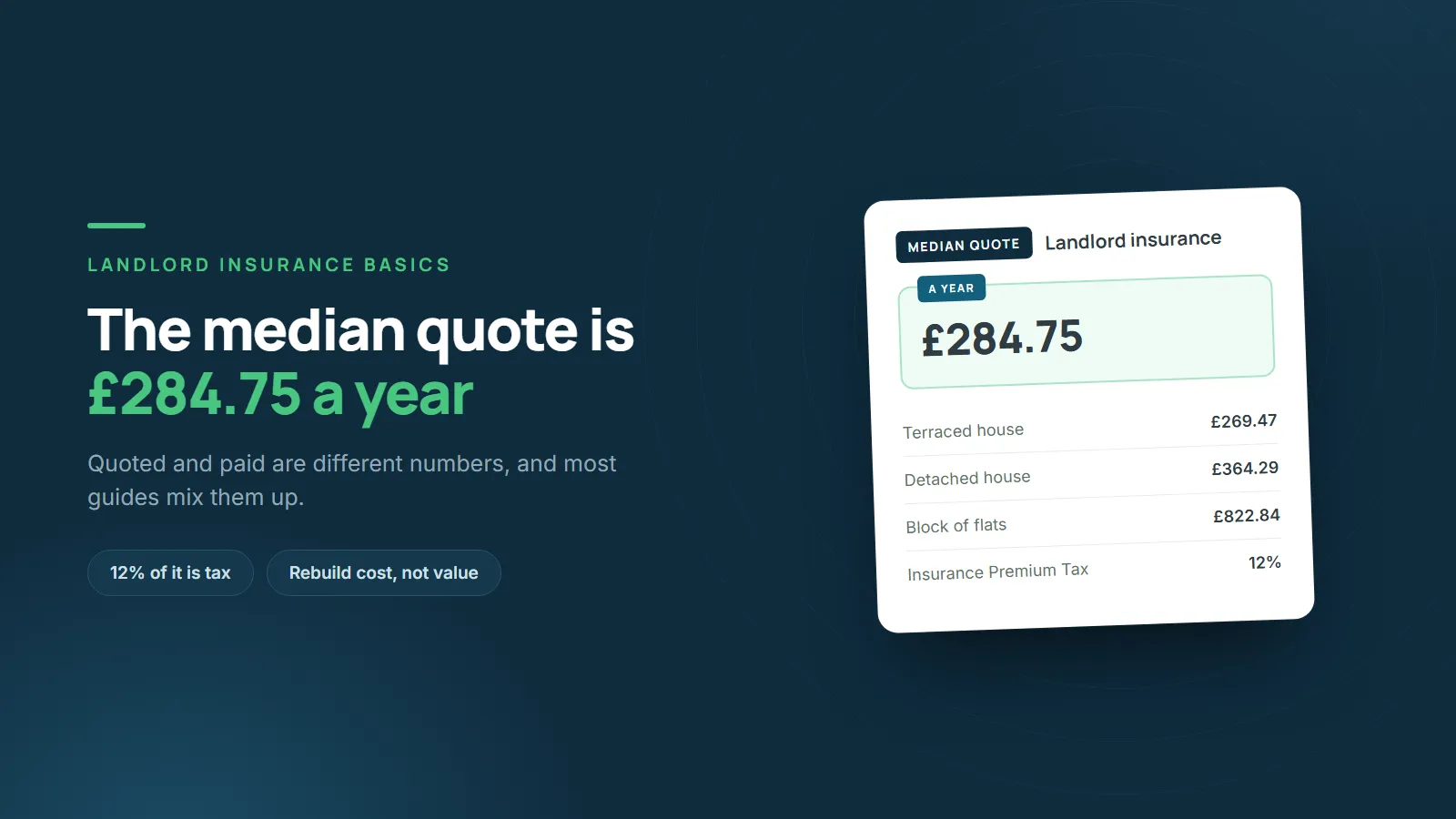
The median quoted premium for landlord insurance in the UK in 2026 was £284.75 a year, according to Alan Boswell Group. Half of quotes came in below that, half above.
That figure is a quote, not a price paid, and the difference matters more than most cost guides admit.
What you will actually pay turns on the rebuild cost of the building, its age and type, who lives in it, and which extras you bolt on.
How Much Does Landlord Insurance Cost in the UK?
£284.75 a year is the median quoted premium, from Alan Boswell Group’s 2026 landlord insurance statistics.
Those are medians of one broker’s own quotes, across its book of landlord business. That is the most useful public number available, and it still only describes quotes that broker produced.
What That Buys
A median-priced policy is buildings cover on a standard house, with property owners liability, let to a working tenant.
It is not a package with every extra attached. Rent guarantee, home emergency and legal expenses are priced separately, and the section below sets out what each adds.
Where It Sits Against the Rent
Put the premium next to the income and it stops looking like a large number.
Zoopla put the average rent on a new UK let at £1,343 a month in September 2026. Against that, £284.75 is about 1.8% of a year’s rent, or just under one week of it.
That calculation is ours, from those two published figures.
Why Do the Published Figures Disagree?
Because some measure what people are quoted and others measure what people paid, and quoted averages run higher.
This is the single reason cost guides contradict each other, and almost none of them say so.
Quoted Against Paid
The £284.75 median is a quote. A quote is a price offered before anyone shops around, haggles, or declines it.
Which? reports that the Association of British Insurers tracks home insurance on a different basis: prices people are “actually paying, rather than quotes”, covering both renewals and new policies.
Why Headline Prices Are Lower Still
Insurer and comparison pages lead with a “from” price, which is the cheapest decile of risk rather than a typical one.
A number like “from £12.95 a month” describes a modern, small, low-risk property let to a low-risk tenant.
It is a real price for somebody. It is not a forecast for you.
What Does It Cost for Your Type of Property?
Property type moves the premium more than anything else in the quote, and flats move it most.
All four tables below are medians of Alan Boswell Group’s 2026 quotes.
By Property Type
| Property type | Median quoted premium |
|---|---|
| Purpose-built block of flats | £822.84 |
| Converted block of flats | £714.07 |
| Detached house | £364.29 |
| Detached bungalow | £311.07 |
| Semi-detached house | £280.00 |
| Terraced house | £269.47 |
| Purpose-built flat | £255.44 |
A whole block costs roughly three times a terraced house, because the policy covers every flat, the common parts and the liability attaching to all of them.
An individual leasehold flat is the cheapest thing on the list, because the freeholder usually insures the structure and the landlord is covering contents and liability rather than the building.
By Size and Age
| Bedrooms | Median | Built | Median |
|---|---|---|---|
| 1 | £224.00 | Before 1850 | £547.35 |
| 2 | £242.00 | 1850 to 1899 | £423.56 |
| 3 | £279.10 | 1900 to 1920 | £319.60 |
| 4 | £377.03 | 1921 to 1944 | £325.85 |
| 5 | £424.74 | 1945 to 1979 | £269.00 |
| 6 | £451.00 | 1980 to 1989 | £230.65 |
Age does more work than bedroom count. A pre-1850 property is quoted at more than double a 1980s one, because period materials cost more to repair and older drainage and wiring fail more often.
Note the turn after 2000. New build quotes tick back up to £275.00, above the 1990s figure, which is not what most people expect.
By Who Lives There
| Tenant type | Median quoted premium |
|---|---|
| Unoccupied | £372.10 |
| Students | £371.96 |
| Self-employed | £340.42 |
| Housing benefit | £287.78 |
| Employed | £275.56 |
| Retired | £264.02 |
An empty property is the most expensive thing on the list. Most standard policies restrict cover after 30 to 60 days of vacancy, which is why a void between tenancies needs unoccupied property cover rather than an assumption.
The spread from the cheapest tenant type to the dearest is about £108 a year. It is real, and it is smaller than the gap between a three bedroom house and a five bedroom one.
Is Landlord Insurance More Expensive Than Home Insurance?
Not reliably, and the usual comparison is unsound because the two figures are built differently.
The ABI’s tracker put the average combined buildings and contents premium at £383 for April to June 2026, up from £375 the previous quarter and 2% below a year earlier.
Comparing Like With Like
That £383 is a price paid, for buildings and contents together, on owner-occupied homes. The £284.75 landlord figure is a quote, usually for buildings cover alone.
Set side by side without that caveat, the numbers appear to show landlord cover is cheaper. They do not show that.
The two are not measuring the same thing.
What the Landlord Policy Adds
Property owners liability, which an owner-occupier policy does not carry, for claims by tenants and their visitors.
Loss of rent, so the income continues while the property cannot be lived in. Cover that survives the building being let to strangers, which a residential policy will not do at all.
What Do the Optional Extras Cost?
Two of the three common extras are cheaper bundled into a policy than bought alone.
| Extra | Added to a policy | Bought standalone |
|---|---|---|
| Rent guarantee, £12k to £50k cover | £195 | £250 |
| Home emergency | £155 | £155 |
| Legal expenses, £50k cover | £60 | £80 |
Which Ones Earn Their Keep
Rent guarantee is the dearest, and the one whose value depends most on your position. One void month on a £1,343 rent costs more than six years of the £195 premium.
Legal expenses cover at £60 is the cheapest line in the table and the one that matters most since possession became slower and more procedural.
The One to Think Twice About
Home emergency cover costs the same either way, at £155, so there is no bundling saving to chase.
It is worth most to a landlord who is far from the property or has no tradespeople on call, and least to one who lives nearby and already has a plumber.
How Much of the Premium Is Tax?
Insurance Premium Tax takes 12% of the standard rate premium, and no insurer can discount it.
This is the part of the price no comparison explains, and it is a tenth of the bill.
What 12% Means in Cash
GOV.UK sets the standard rate at 12%, applying since 1 June 2017, with a higher 20% rate reserved for travel, appliance and some vehicle insurance. Property cover takes the standard rate.
On the £284.75 median, that is roughly £30.51 of tax sitting on about £254.24 of insurance. Our arithmetic, from the published rate.
Why It Matters at Renewal
Two quotes that look £30 apart may be identical policies priced the same, with the gap sitting somewhere else entirely.
It also means a premium cannot fall below the tax floor, however much cover is stripped out. There is a hard bottom to the price.
What Is That Premium Buying?
One escape of water claim costs about 26 years of the median premium.
The cost question is usually asked without its other half, which is the size of the loss being insured against.
The Claim Figures
The NRLA sets out Total Landlord’s claims data: the average escape of water claim paid rose from £2,844 in 2020 to £7,501 in 2024.
Storm damage averaged £3,636 in 2024. Fire claims are rarer and averaged nearly £36,000 over five years, which is about 126 years of median premiums.
The Gap Nobody Prices
Alan Boswell Group estimates about 14% of UK landlords, nearly 400,000 people, hold no specialist landlord insurance at all.
A residential policy on a let property is not cheap cover. It is usually no cover, because letting the property breaches it, and that is discovered at the claim rather than at the quote.
How Do You Bring the Cost Down?
Get the rebuild cost right first. It is the largest number in the quote and the one most often wrong.
Everything below is ordered by how much it tends to move the price.
Insure the Rebuild, Not the Value
Buildings cover is priced on what it costs to clear the site and rebuild, not what the property would sell for. On most housing the rebuild figure is well below market value.
A landlord who enters the purchase price is buying cover they can never claim, and paying for it every year. A landlord who guesses low risks the claim being scaled back.
Price the Extras Separately
Quote the policy with and without each add-on. Two of the three are cheaper bundled, one is not, and the difference is only visible if you ask twice.
Raise the Excess Deliberately
A higher voluntary excess lowers the premium. Set it at a level you could pay the same week without borrowing, because the excess is due before the repair.
Do Not Let It Renew Itself
The renewal invitation is a price for a customer who is not looking. Comparing at renewal is the single largest saving available to most landlords, and it costs an afternoon.
Keep the Record Clean
Small claims cost more than they return once the five year loading is counted. Where the loss is close to the excess, paying it is often cheaper than claiming it.
Tell the Insurer the Truth About Occupancy
Student lets, housing benefit tenancies and empty periods all change the price, and all of them void the policy if they are not declared.
The premium saved by leaving something out is always smaller than the claim refused because of it.